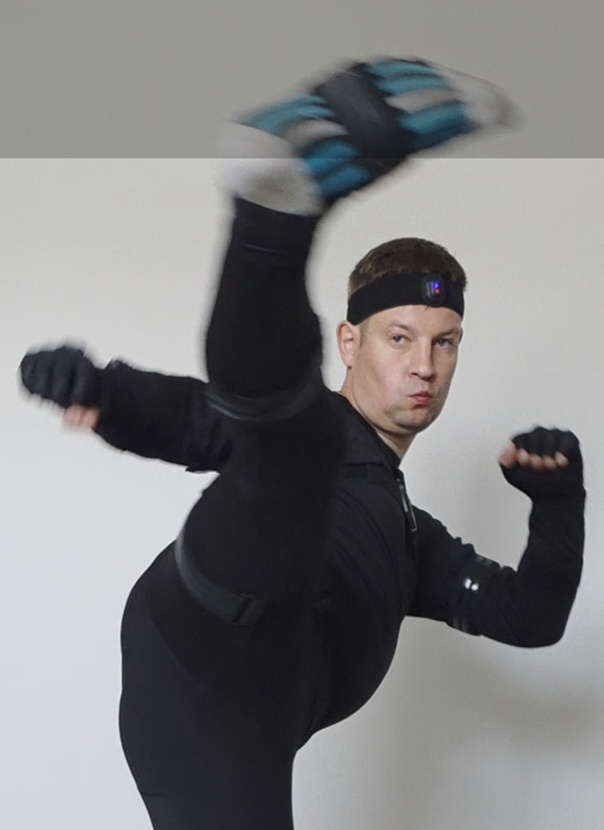
In the gym we argue which kick is “stronger”. In Scientific Reports we put a strain-gauge platform behind a padded disc. Nine elite ITF athletes — four men, five women — delivered 197 measured kicks. Question: how do turning and side kicks compare, and what do gender, body mass and height contribute?
On average the side kick produced higher impact force than the turning kick (p < 0.001). That held across genders. It does not mean you abandon dollyo chagi in sparring — speed and control still decide many exchanges. Force is one coordinate.
What the tables show
For women, median turning-kick force sat around 1347–1440 N by leg; side-kick medians about 1652–1900 N, with maxima past 5000 N. For men, turning medians roughly 2600–2794 N; side-kick medians about 4800–4912 N. Laboratory impacts at solar-plexus height — not a promise against a moving opponent.
Regression highlighted gender and kick type, with mass and height also linked to pressure force. Males averaged higher, yet some women after specialised training exceeded some male values. That should kill lazy dojang stereotypes.
Laterality and limits
Several right–left contrasts were non-significant. “Dominant leg always hits harder” is a hypothesis, not doctrine. n = 9 elites: enough for clear technique/gender effects here, not population norms for every belt.
Takeaway
Coach the side kick for mass transfer in a linear thrust; train turning kicks for speed and timing separately. Measure before you mythologise. Related notes: publications, IMU diagnostics.
Protocol detail matters when you quote newtons. Athletes chose target height within ITF striking zones, typically at solar-plexus level, and were instructed to generate maximal impact without a time cap. A few trials recorded four or six kicks instead of five because of human or registration error — the paper is transparent about that messiness. Peak forces were extracted with a Python/SciPy peak finder after export from the measurement stack, then analysed non-parametrically because Shapiro–Wilk rejected normality.
Beta coefficients in the multivariate model put gender and kick type at the centre of the force story, with body mass and height contributing additional explained variance. Heteroscedasticity was checked visually; significance stayed at p < 0.05. None of that licenses a social-media claim that “side kicks are always twice as strong” — look at the interquartile ranges and maxima before you meme the medians.
Competition reality still favours the turning kick for many scoring exchanges. Strength on a plate is a capacity; match craft is a separate skill. Use the dataset to stop under-training the side kick’s mass-transfer pattern, not to rewrite the rulebook.
Data collection sat at the Center for Human Movement Analysis, Jan Długosz University. Warm-up was self-directed (~10 min). Each athlete performed side kicks then turning kicks per leg with rests between blocks. Wilcoxon tests handled paired kick and limb contrasts; regression summarised predictors of pressure force. Open access via Nature means you can audit the figures yourself instead of trusting a blog paraphrase.
How to read this without Instagram physics
Popular posts about martial arts love single numbers. Peer-reviewed combat-sport papers usually deliver distributions, small elite samples, and caveats. When we quote a median or a mean here, it is a laboratory reading under a stated protocol — pad or plate geometry, instruction to go maximal, a defined stance. Change the instruction or the target and the number moves. That is not a failure of science; it is why measurement exists.
Biokineticum’s role in these projects is the same as on the clinic floor: prefer a boring sensor over a loud opinion. If you want help instrumenting kicks or punches, or you need a physiotherapist who also writes the analysis code, the contact page is the honest next step — not a promise that your next roundhouse will match a table in Scientific Reports.
Final filter: if one table makes you rewrite an entire mesocycle or clinic pathway, pause. A single paper is a coordinate, not a season plan. Cross-check effect direction against the other ORCID-series posts, open the DOI, then edit the syllabus. We would rather see three coherent measurement sessions than one dramatic chart cropped for social media.
References
- Góra T, Wąsik J, Mosler D, Ortenburger D, Kuberski M. A comparing the strength of taekwondo turning and side kicks in relation to athletes’ gender, body weight and height. Scientific Reports. 2025. 15:19558. doi:10.1038/s41598-025-04785-9
Measurement-led biomechanics and clinical tools at Biokineticum.