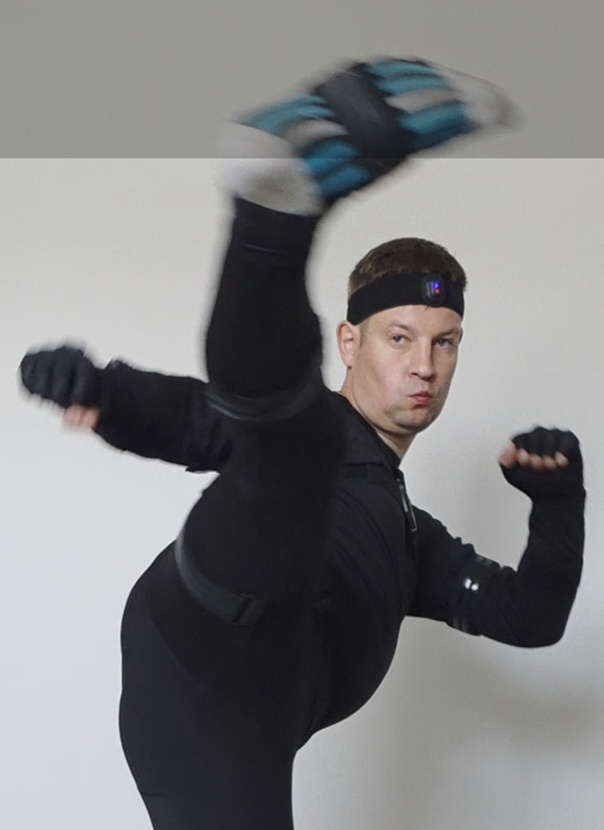
A physiotherapy visit does not have to start with a car ride and a suit of reflective markers. For a large class of questions — can this shoulder still reach overhead, does this stance drift, how does a squat look from the side — a laptop camera is already a sensor. At Biokineticum I run telerehabilitation sessions that analyse joint kinematics and balance in real time from that camera, without extra IMUs, force plates, or a proprietary app on your phone.
The pipeline is deliberately narrow. During the call we use specialised machine-learning models, including YOLOv8, to extract kinematic data from the webcam feed: joint positions, segment orientations, range of motion. The model is not a chatbot and it is not “an AI that talks to patients”. We do not send the session through a large language model, and we do not upload your voice or image to an external inference farm. The analytical work stays on the kinematic stream. That is the whole point of the zero-LLM constraint: clinical video is not a prompt.
What the camera actually measures
Range of motion is the first channel. If you can stand far enough from the lens for the relevant joints to be visible, the model tracks landmarks frame by frame and the angles follow from those landmarks. I still watch the movement. The software measures; I interpret. If a hip looks limited on camera, we stop and test it as we would in the room — only the tape measure is digital.
Balance is treated as a second channel, not a side effect of the stick figure. Besides joint angles, the algorithm estimates the centre of gravity and builds a live sway map. That is not a laboratory force-plate centre-of-pressure trace, and I will not pretend it is. It is a camera-derived picture of how the trunk and pelvis drift while you stand or shift weight. For a clinician on the same call it is enough to see asymmetry and to decide what to test next. Processing stays local to the kinematic data; the point is anonymity, not a cloud dashboard of your face.
Related open-source work sits next to this visit, not inside it. The Web Joint Analyzer on our GitHub uses MediaPipe and Streamlit for markerless joint-angle work from a webcam or a video file. Telerehabilitation sessions themselves are described on the site as YOLOv8 kinematics plus a sway map. Different tools, same idea: you should not need a motion-capture volume to get a number out of a joint.
What the literature says
Peer-reviewed work on monocular, markerless pose estimation does not claim optical-lab equivalence. It does support a narrower claim that is useful in clinic: for many rehab motions, webcam-based pipelines can produce usable range-of-motion estimates when lighting, clothing, and camera framing are honest.
Latreche and colleagues evaluated a MediaPipe-based system against goniometry for selected rehabilitation motions and reported reliability and validity consistent with telerehabilitation follow-up for those studied movements — not a blank cheque for every joint and every angle (Measurement, 2023). Clemente et al. tested MediaPipe Pose on typical musculoskeletal physiotherapy exercises from monocular 2D video; agreement with ground truth was strongest for motions such as shoulder abduction, elbow flexion and squat, and weaker where occlusion or depth ambiguity dominates (Sensors, 2024). Wang, Smith and Zhu compared a webcam machine-learning 3D ROM pipeline (BlazePose) with marker-based capture: high test–retest reliability overall, with joint-dependent agreement versus the optical reference — again, usable for clinical change detection in some planes, not a substitute for a calibrated lab (PLOS ONE, 2023).
Separately, systematic reviews of physiotherapist-led telerehabilitation find remote exercise delivery often non-inferior to face-to-face care for function, quality of life and satisfaction in musculoskeletal (and related) populations. That is the clinical delivery frame; markerless kinematics is an optional measurement layer inside it. I unpack those reviews in Is remote physiotherapy as good as in-person?.
Honest limits, stated once: markerless webcam tracking is not optical mocap. Depth errors, unusual poses and self-occlusion still bite. The visit remains PT-led; the model does not diagnose.
The call runs on a messenger you already have
The session uses end-to-end encrypted video on a channel you pick: Signal, Telegram, WhatsApp, Session, FaceTime, Google Meet, or Jitsi. We do not ask you to create an account on a medical SaaS platform or to install a clinic-branded client. You write to biokineticum@proton.me or use the contact form, we agree a time and a payment method, and at the appointed minute you answer a video call. Forty-five minutes: motion analysis, a discussion of what the kinematics showed, and a rehab plan you can actually do at home.
That messenger list is a privacy choice, not a marketing badge. If the video never leaves an E2E channel, and the pose model is not an LLM with a retention policy, then the remaining leak is usually the payment. Bank transfer is the default. Bitcoin, Monero, and USDT are available if you want the settlement to stay as private as the call. Wallet details go out only when the booking is confirmed.
Price, setup, and what this is not
A consultation is 100 PLN — roughly 25 USD or 23 EUR. The number is on the telerehabilitation page because the stack is simple: your camera, an encrypted messenger, kinematic models, and a physiotherapist who also writes the analysis software. There is no extra sensor kit in the post.
What you need on your side is unglamorous. A webcam or a phone on a stable stand, enough floor to step and raise an arm, clothing that does not hide the joints we need to see, and a messenger that actually encrypts. If the room is dark or the camera is pointing at the ceiling, YOLOv8 will not invent landmarks. Markerless capture is only as honest as the image.
This is not a substitute for optical motion capture in a lab. It is not Perception Neuron 3, a Biodex isokinetic report, or an IMU strike trace — we do that work too, on different days, with different hardware. It is also not a diagnosis by algorithm. If you need a clinic with a plinth, imaging, or a hands-on test I cannot run through a lens, I will say so. For range of motion and balance from home, the webcam session is the shortest path that still produces numbers you can act on.
References
- Latreche A, Kelaiaia R, Chemori A, Kerboua A. Reliability and validity analysis of MediaPipe-based measurement system for some human rehabilitation motions. Measurement. 2023;214:112826. doi:10.1016/j.measurement.2023.112826
- Clemente C, Chambel G, Silva DCF, Montes AM, Pinto JF, Silva HP. Feasibility of 3D body tracking from monocular 2D video feeds in musculoskeletal telerehabilitation. Sensors. 2024;24(1):206. doi:10.3390/s24010206
- Wang XM, Smith DT, Zhu Q. A webcam-based machine learning approach for three-dimensional range of motion evaluation. PLOS ONE. 2023;18(10):e0293178. doi:10.1371/journal.pone.0293178
- Muñoz-Tomás MT, et al. Telerehabilitation as a therapeutic exercise tool versus face-to-face physiotherapy: a systematic review. Int J Environ Res Public Health. 2023;20(5):4358. PubMed 36901375
Encrypted messenger of your choice. YOLOv8 joint kinematics and live balance tracking. No LLM. Bank transfer or crypto (BTC, XMR, USDT).