“Is remote physiotherapy as good as coming to the clinic?” is the question patients ask before they ask about cameras or encryption. The honest answer is not a slogan. It is a stack of systematic reviews: for many musculoskeletal (and related) populations, physiotherapist-led exercise telerehabilitation is often non-inferior to face-to-face care on function, quality of life and satisfaction — with clear limits, and without promising miracles for every diagnosis.
This post summarises that evidence frame, then places Biokineticum’s model inside it without overclaiming. We run live PT sessions over end-to-end encrypted messengers, with optional markerless kinematics (YOLOv8 ROM and a live sway map), and without routing clinical video through a large language model. The reviews below are about delivery of therapeutic exercise by a physiotherapist at a distance. They are not validations of our specific pose model.
What the reviews actually compared
Muñoz-Tomás and colleagues systematically reviewed randomised trials of therapeutic exercise delivered by telerehabilitation versus face-to-face physiotherapy in adults. Across the included trials, outcomes for function, quality of life and satisfaction were generally similar between remote and in-person arms; adherence and satisfaction were also reported as comparable where measured (Int J Environ Res Public Health, 2023; PubMed 36901375). Populations spanned musculoskeletal, cardiac and neurological conditions — which is useful context, and also a reminder not to flatten every diagnosis into one number.
Wicks and colleagues focused on older adults (mean age ≥ 65) receiving physiotherapist-led, exercise-based telerehabilitation. In their systematic review and meta-analysis (eleven studies, about 1,400 participants with musculoskeletal and cardiopulmonary conditions), telerehabilitation was safe, well adhered to, and non-inferior to face-to-face physiotherapy for range of motion, strength, six-minute walk distance, timed up-and-go and quality of life, with signals of lower health-service costs versus clinic care; versus no intervention, remote exercise improved several functional outcomes (Age Ageing, 2023; PMC10657214). That is a strong statement for access in ageing populations — not a claim that pain always improves equally (the same review notes more cautious findings on pain versus face-to-face care).
A broader rapid systematic review of allied-health interventions delivered by telehealth (physiotherapy among other disciplines) similarly found that many outcomes — including knee range, health-related quality of life and pain in relevant trials — improved similarly to face-to-face delivery, with comparable satisfaction and adherence, while calling out remaining evidence gaps in some allied disciplines (Raymond et al., Healthcare, 2024).
How to read “non-inferior” without marketing fog
Non-inferiority in these reviews means: for the outcomes and populations studied, remote PT-led exercise programmes did not systematically underperform in-person care. It does not mean every patient should stay home. It does not erase the need for hands-on tests, imaging decisions, or a plinth. It does not validate a chatbot that “does physio”. The active ingredient in the better-supported studies is still a physiotherapist designing and supervising exercise — often by videoconference — not an unsupervised app.
Where evidence is thinner (specific orthopaedic tests that require palpation, complex neurological exams, red-flag pathways), remote care is a bridge or a follow-up tool, not a full substitute. That is clinical judgment, not a citation.
Where Biokineticum sits in that frame
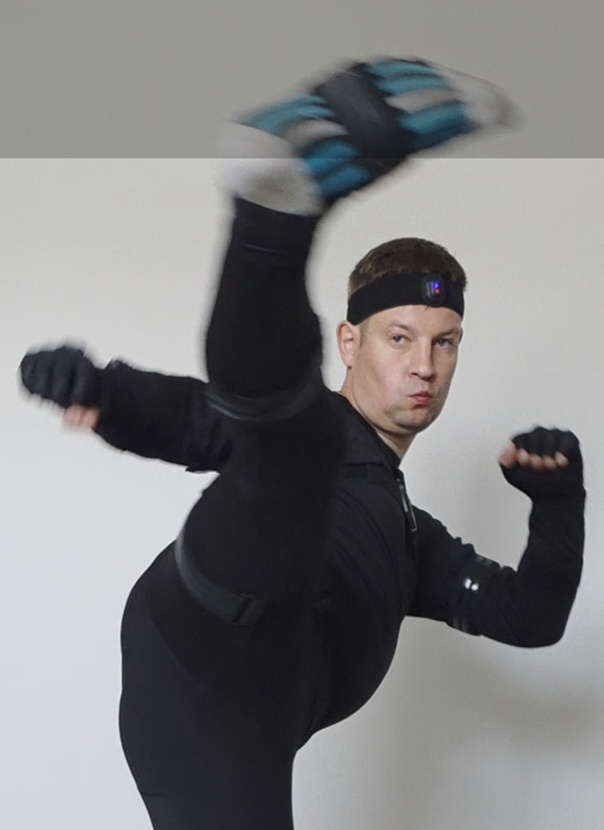
Our telerehabilitation visit is built to match the delivery model the reviews support: a live physiotherapist, synchronous video, therapeutic exercise and movement coaching. On top of that we add optional markerless kinematics from the webcam — joint ROM and a camera-derived sway map — so the session produces numbers you can track, not only adjectives. We deliberately do not send the session through an LLM. Clinical video is not a prompt; pose estimation is not a diagnosis.
What we do not claim: that YOLOv8 equals optical motion capture; that a sway map equals a force-plate COP trace; that remote care is always better or cheaper for every condition; that any particular percentage of “our patients improved”. Markerless measurement literature is separate and more cautious — I cover that in the webcam ROM post. The service price (~100 PLN / ~25 USD for 45 minutes) reflects a simple stack: your camera, an E2E messenger you already use, kinematic models, and a PT who also writes the software.
Practical takeaway
If your question is “can PT-led exercise work at a distance for many MSK patients?”, the reviews above say: often yes, on function, QoL and satisfaction, with honest caveats. If your question is “can I get useful ROM and balance information from a home webcam while a physiotherapist watches?”, that is a narrower engineering claim supported by emerging markerless studies — and still subordinate to clinical judgment on the call.
Book when that combination is what you want. Decline when you need a hands-on clinic day. Both answers are scientific.
References
- Muñoz-Tomás MT, et al. Telerehabilitation as a therapeutic exercise tool versus face-to-face physiotherapy: a systematic review. Int J Environ Res Public Health. 2023;20(5):4358. PubMed 36901375 · doi:10.3390/ijerph20054358
- Wicks M, et al. Physiotherapist-led, exercise-based telerehabilitation for older adults improves patient and health service outcomes: a systematic review and meta-analysis. Age Ageing. 2023. PMC10657214 · PubMed 37979183
- Raymond MJ, et al. Delivery of allied health interventions using telehealth modalities: a rapid systematic review of randomized controlled trials. Healthcare. 2024;12(12):1217. doi:10.3390/healthcare12121217 · PubMed 38921331
Live physiotherapist + optional markerless kinematics over an E2E messenger. No LLM. ~100 PLN / ~25 USD for 45 minutes.