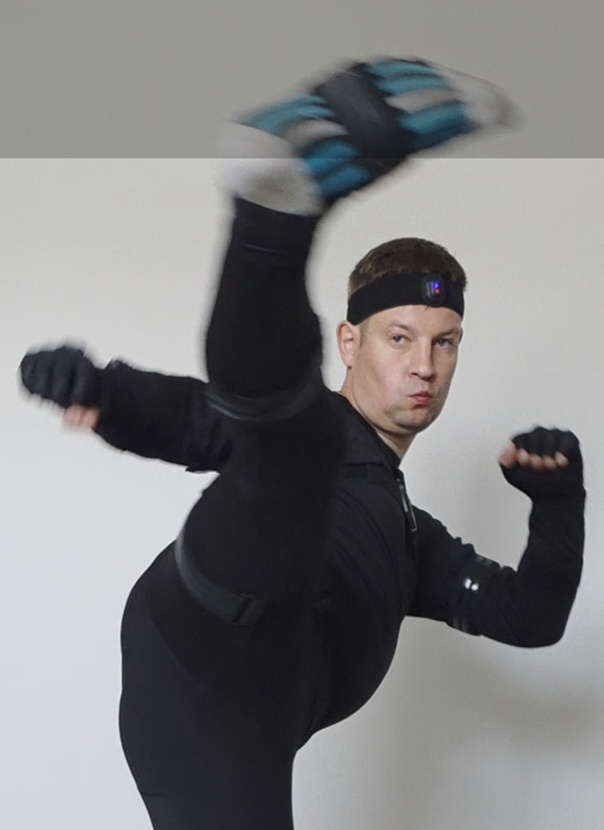
Citing a publication from the Journal of Men's Health (2022), I tackled a problem frequently encountered by combat sports coaches: how does strike kinematics change depending on the selected version of a technique? Within Taekwon-do ITF, there are two primary versions of the roundhouse kick: the traditional and the sport variant.
How Did We Conduct the Study?
We invited 15 Taekwon-do masters to the laboratory (Human Motion Lab). In total, they executed an astounding 180 kicks, and every single movement was explicitly analyzed using stereophotogrammetry based on a 10-infrared-camera system (NIR Vicon MX-T40).
Key Discoveries
- The research corroborated that the sport version significantly differs from the traditional one.
- Substantial differences were demonstrated in peak velocity and the execution time for both limbs. This indicates that the type of competition – mandating a specific sort of technique – directly dictates the dynamics of an athlete's strike.
What Does This Mean in Practice?
The evolution of sports techniques has an unambiguous goal – the speed necessary to score a point. Athletes and coaches must realize that traditional forms (often more powerful and emphasizing a different area of contact) boast a different movement specialty. Therefore, formulating suitable biomechanical training depends on the specific competition framework an athlete plans to enter.
Wąsik J., Mosler D., Góra T., Ortenburger D., Chalimoniuk M., Langfort J. (2022). Kinematic Differences between Traditional and Sport Version of Roundhouse Kick Executed by Male Taekwon-do Masters. Journal of Men's Health, 18(6), 138.