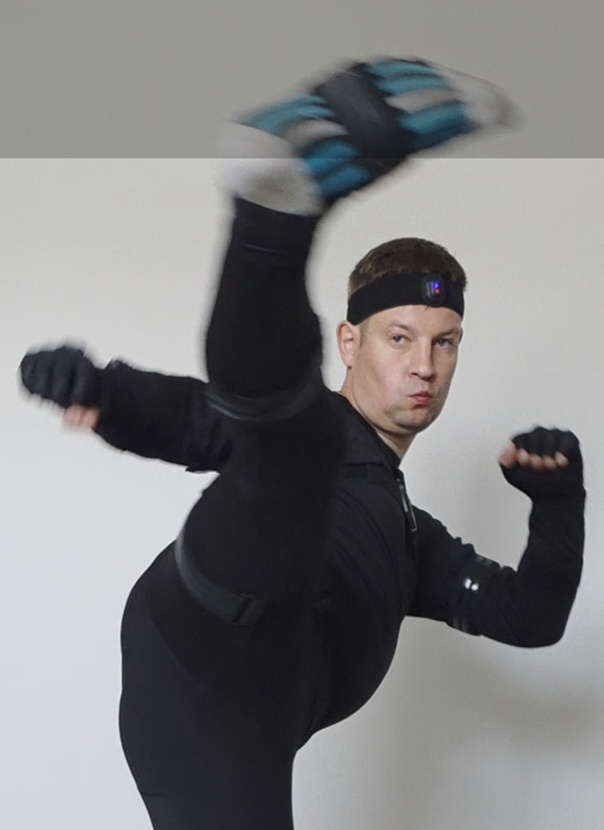
Force differences between techniques are obvious once you instrument them. Sex differences in how athletes recruit effective mass are subtler — and more useful for coaching. Nine adult black-belt ITF athletes (four men, five women) kicked an AMTI plate through a padded target with a Noraxon Ultium IMU near the foot.
ANOVA-style contrasts showed large differences in pressure force between kick types: turning kick F = 84.14, p < 0.001; side kick F = 46.62, p < 0.001 (as reported for the analysed force contrasts). The paper focuses on how sex interacts with effective-mass utilisation rather than declaring a single “better” gender.
Practical line: do not copy-paste male side-kick drills onto women (or vice versa) and expect the same mass-transfer profile. Build separate technical cues for organising the trunk and stance at impact. Sample is small and elite — mechanism first, norms later.
Equipment: AMTI MC12-2K series plate behind a padded target, Ultium IMU near the foot, temporal synchronisation. That stack is the same family used across several of our kick papers, which helps when you compare effect directions even if samples differ.
Sex differences in utilising effective mass are not a euphemism for “women kick weakly”. They are a prompt to inspect how trunk orientation, stance width and hip strategy differ at contact. If your cues are copied from a male national team video, you may be asking for a mass-transfer pattern that another body organises differently.
Large F statistics on kick-type force contrasts tell you the technique factor is not subtle. The interesting coaching work is the sex×mechanics interaction — which this paper opens rather than closes. Nine black belts: mechanism-seeking design, not a census.
Minimum age 18 and black-belt status kept the sample technically literate. Men and women trained in the same art under comparable grading standards, which makes sex contrasts about utilisation patterns more interpretable than mixed-style scrapes from the internet.
How to read this without Instagram physics
Popular posts about martial arts love single numbers. Peer-reviewed combat-sport papers usually deliver distributions, small elite samples, and caveats. When we quote a median or a mean here, it is a laboratory reading under a stated protocol — pad or plate geometry, instruction to go maximal, a defined stance. Change the instruction or the target and the number moves. That is not a failure of science; it is why measurement exists.
Biokineticum’s role in these projects is the same as on the clinic floor: prefer a boring sensor over a loud opinion. If you want help instrumenting kicks or punches, or you need a physiotherapist who also writes the analysis code, the contact page is the honest next step — not a promise that your next roundhouse will match a table in Scientific Reports.
Final filter: if one table makes you rewrite an entire mesocycle or clinic pathway, pause. A single paper is a coordinate, not a season plan. Cross-check effect direction against the other ORCID-series posts, open the DOI, then edit the syllabus. We would rather see three coherent measurement sessions than one dramatic chart cropped for social media.
References
- Góra T, Mosler D, Ortenburger D, Wąsik J. Sex differences in utilizing effective mass among taekwon-do athletes performing turning and side kick. Physical Activity Review. 2024. doi:10.16926/par.2024.12.23
Measurement-led biomechanics and clinical tools at Biokineticum.