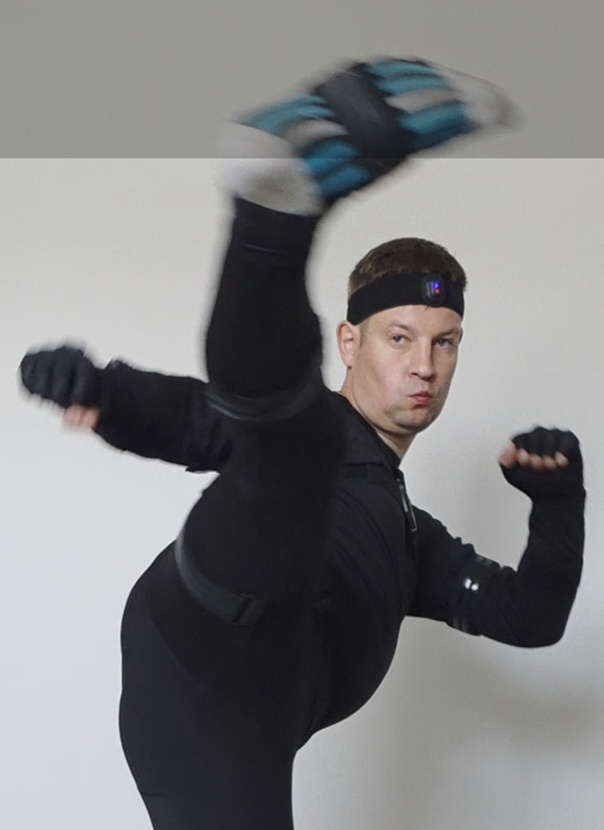
Everyone films the kicking foot. Fewer people watch the sternum and the opposite shoulder. Thirteen elite taekwon-do athletes kicked a table-tennis ball three times per leg while a 10-camera Vicon MX-T40 tracked toes, knees, hips, shoulders, elbows, hands and sternum.
Maximal velocity of the sternum and opposite shoulder differed statistically between sides. Correlations between the timing of peak segment velocities and peak toe velocity were stronger for the left kick, despite athletes declaring a right-leg preference. Small, non-resistant targets make those coordination details visible.
Coaching implication: bilateral “sameness” is a myth worth measuring. If you only cue the kicking leg, you ignore half the kinetic story. Limits: elite sample, ball target — excellent for kinematics, not a force-plate substitute.
Marker set covered the kinematic chain that coaches often ignore: sternum, shoulders, elbows and hands alongside the kicking limb. The target was a table-tennis ball — low resistance, high demand on accuracy — which is exactly when compensatory trunk and arm strategies show up.
Declared limb preference did not match the richer correlation structure on the left side. That is a quiet warning against building entire programmes around what athletes say is their favourite leg. Measure both; periodise both; return-to-sport both.
Significant sternum and opposite-shoulder velocity differences by side are not aesthetic trivia. They are hints about how rotation and counter-rotation are organised. If your roundhouse looks “arm-dead” on one side, the foot may not be the only bottleneck.
Three kicks per leg to a light ball reduce fatigue confounds and emphasise accuracy. NIR Vicon MX-T40 at the Human Motion Lab remains a gold-standard optical reference next to the IMU-heavy papers in this ORCID batch.
How to read this without Instagram physics
Popular posts about martial arts love single numbers. Peer-reviewed combat-sport papers usually deliver distributions, small elite samples, and caveats. When we quote a median or a mean here, it is a laboratory reading under a stated protocol — pad or plate geometry, instruction to go maximal, a defined stance. Change the instruction or the target and the number moves. That is not a failure of science; it is why measurement exists.
Biokineticum’s role in these projects is the same as on the clinic floor: prefer a boring sensor over a loud opinion. If you want help instrumenting kicks or punches, or you need a physiotherapist who also writes the analysis code, the contact page is the honest next step — not a promise that your next roundhouse will match a table in Scientific Reports.
Final filter: if one table makes you rewrite an entire mesocycle or clinic pathway, pause. A single paper is a coordinate, not a season plan. Cross-check effect direction against the other ORCID-series posts, open the DOI, then edit the syllabus. We would rather see three coherent measurement sessions than one dramatic chart cropped for social media.
References
- Wąsik J, Mosler D, Ortenburger D, Góra T, Podstawski R. Differences in Velocities of Crucial Body Segments while Executing Roundhouse Kicks for Both Sides. Journal of Human Kinetics. 2023. doi:10.5114/jhk/159451
Measurement-led biomechanics and clinical tools at Biokineticum.