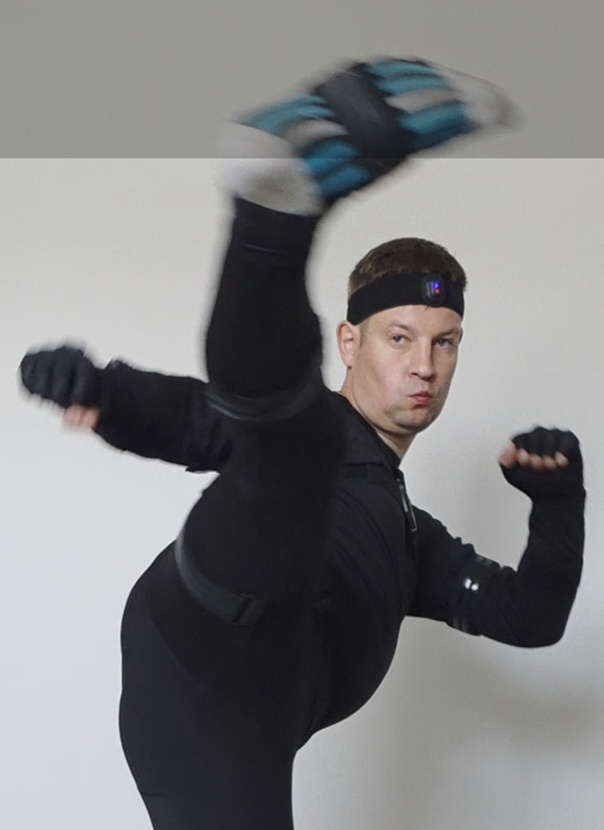
We already wrote about effective mass in jab vs cross. This 2025 Applied Sciences study widens the lens: thirty trained male boxers (mass 86.4 ± 1.4 kg, ~6 years experience) threw jab, cross, lead hook and rear hook into an AMTI plate with 16-oz gloves and a fist IMU. Effective mass Me = Fmax / a.
Straight punches carried higher effective mass than hooks (Kruskal–Wallis H = 235.24, p < 0.001, η² = 0.468) even though hooks produced greater peak forces and higher fist acceleration (rear hook 212.61 ± 98.43 m/s²). Cross Me 31.17 ± 16.20 kg, jab 30.39 ± 15.09 kg; lead/rear hooks about 14.38 and 12.56 kg. Effective Mass Index ~36–37% on straights vs ~15–17% on hooks.
Impulse was highest on the jab (63.80 ± 15.36 N·s). Regression for pressure force (R² ≈ 0.79) was driven by effective mass, fist acceleration and impulse; body composition and training tenure were largely non-predictive of Me. Distinct from the earlier jab/cross-only note: here hooks are in the model, and “harder feeling” ≠ better mass transfer.
Limits: men only, lab plate, experience band ~6 ± 2 years. Still the coaching line is sharp — train linear stiffness and contact timing, not only whip speed. See also the earlier effective-mass boxing article.
Participants trained in Częstochowa clubs; inclusion required ≥1 year boxing or national-level results, injury-free status, and readiness to strike hard in 16-oz gloves. Body composition via Garmin Index S2 entered the models and largely failed to explain effective mass — a useful antidote to “more muscle equals more Me”.
Rear-hook fist acceleration led the pack, yet Me and impulse/acceleration ratios favoured straights. The pedagogical line writes itself: do not confuse distal whip with axial mass transfer. Impulse on the jab being highest underscores contact duration as a training target — “sticking” the fist without arm-wrestling the pad.
This article coexists with our earlier jab/cross effective-mass explainer; it does not replace it. Hooks are the new information. Laboratory plates still are not opponents; wearable fight capture is future work the discussion section already flags.
ICC reliability across repeated punches was good-to-excellent (jab 0.85, cross 0.89, lead hook 0.93, rear hook 0.82), which supports reading technique contrasts without waving fatigue as a get-out clause for twenty hard shots. Zenodo hosts the dataset (10.5281/zenodo.14966351) if you want to re-run the scripts.
How to read this without Instagram physics
Popular posts about martial arts love single numbers. Peer-reviewed combat-sport papers usually deliver distributions, small elite samples, and caveats. When we quote a median or a mean here, it is a laboratory reading under a stated protocol — pad or plate geometry, instruction to go maximal, a defined stance. Change the instruction or the target and the number moves. That is not a failure of science; it is why measurement exists.
Biokineticum’s role in these projects is the same as on the clinic floor: prefer a boring sensor over a loud opinion. If you want help instrumenting kicks or punches, or you need a physiotherapist who also writes the analysis code, the contact page is the honest next step — not a promise that your next roundhouse will match a table in Scientific Reports.
Final filter: if one table makes you rewrite an entire mesocycle or clinic pathway, pause. A single paper is a coordinate, not a season plan. Cross-check effect direction against the other ORCID-series posts, open the DOI, then edit the syllabus. We would rather see three coherent measurement sessions than one dramatic chart cropped for social media.
References
- Kacprzak J, Mosler D, Tsos A, Wąsik J. Biomechanics of Punching—The Impact of Effective Mass and Force Transfer on Strike Performance. Applied Sciences. 2025. doi:10.3390/app15074008
Measurement-led biomechanics and clinical tools at Biokineticum.