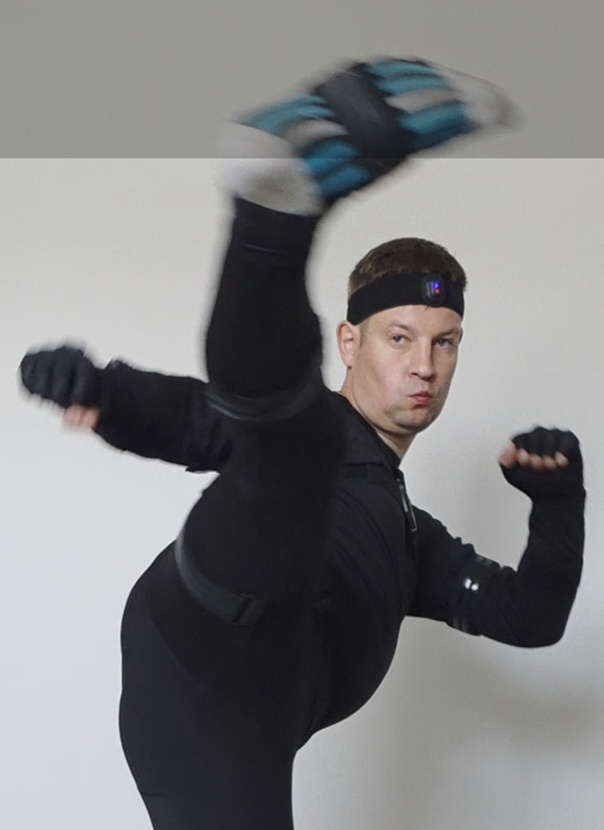
Same facility, same 47 adult men (mean age 24.3 years): 19 with documented alcohol or drug dependence, 28 without. Six 30-second standing tasks mixed bipedal/unipedal and eyes open/closed on a stabilometric platform plus a trunk IMU. We looked at linear sway (path, ellipse area) and nonlinear metrics (sample entropy, fractal dimension, Lyapunov exponent).
Where instability showed up
The group with a dependence history showed greater instability, especially with eyes closed and on one leg, with more irregular anterior–posterior sway. IMU trunk kinematics suggested less selective neuromuscular control. Non-addicted men used tighter, more targeted strategies; the dependence group leaned on broader compensatory patterns.
Clinical reading without stigma
The conclusion is careful: substance dependence is associated with compromised postural stability in incarcerated men. Balance testing can flag functional impairment and guide prison physiotherapy — it does not summarise a person. Neurological exclusions and physical ability were part of inclusion; this is not a study of acute intoxication.
Why pair it with the psych pilot
The companion JCM paper found little group separation on CMJ/FMS/questionnaires. Posture under sensory challenge told a different story. That is a useful lesson for programme design: pick the right stressor before you declare “no difference”.
Nonlinear sway metrics (sample entropy, fractal dimension, Lyapunov exponent) matter because linear path length alone can miss irregular control. Eyes-closed and unipedal conditions remove crutches that mask deficit in quiet bipedal stance — which is why the dependence group’s story appeared there first.
Pair this with the companion psych-profile pilot: different tools, same cohort, different signal. That is an argument for multimodal assessment in correctional physiotherapy, not for cherry-picking the friendlier table.
Rehabilitation inside custody should treat balance training as function and safety, never as punishment theatre. IMU trunk data give coaches and clinicians a shared language for “how” someone sways, not only “how far”.
Nonlinear sway metrics (sample entropy, fractal dimension, Lyapunov exponent) matter because linear path length alone can miss irregular control. Eyes-closed and unipedal conditions remove crutches that mask deficit in quiet bipedal stance — which is why the dependence group’s story appeared there first.
Pair this with the companion psych-profile pilot: different tools, same cohort, different signal. That is an argument for multimodal assessment in correctional physiotherapy, not for cherry-picking the friendlier table.
Rehabilitation inside custody should treat balance training as function and safety, never as punishment theatre. IMU trunk data give coaches and clinicians a shared language for “how” someone sways, not only “how far”.
Where this sits in the lab
Biokineticum’s public notes exist so practitioners can reach the DOI without drowning in jargon — and so athletes, teachers and clinicians see that combat-sport science also publishes on prisons, faith, fair play, sauna physiology and disability policy. Soft topics still deserve hard methods: sample sizes, instruments, effect directions and explicit limits.
If you teach, treat or coach from these findings, copy the reference list into your syllabus, open the full text, and write down what you will measure next week. That is the only CTA that always fits.
Reading notes
Psychosocial and public-health papers describe associations in defined samples — not moral verdicts about individuals. We keep the language descriptive, avoid stigma, and point you to the DOI for methods and limits.
If the topic touches your clinic, classroom or programme design, treat this post as a map to the paper, not a substitute for it.
References
- Błażkiewicz M, Wąsik J, Kędziorek J, Bandura W, Kacprzak J, Radecki K, Kowalewska K, Mosler D. Assessment of Postural Stability in Semi-Open Prisoners: A Pilot Study. Journal of Clinical Medicine. 2025. 14(18):6399. doi:10.3390/jcm14186399
Measurement-led biomechanics, health psychology and clinical tools at Biokineticum.