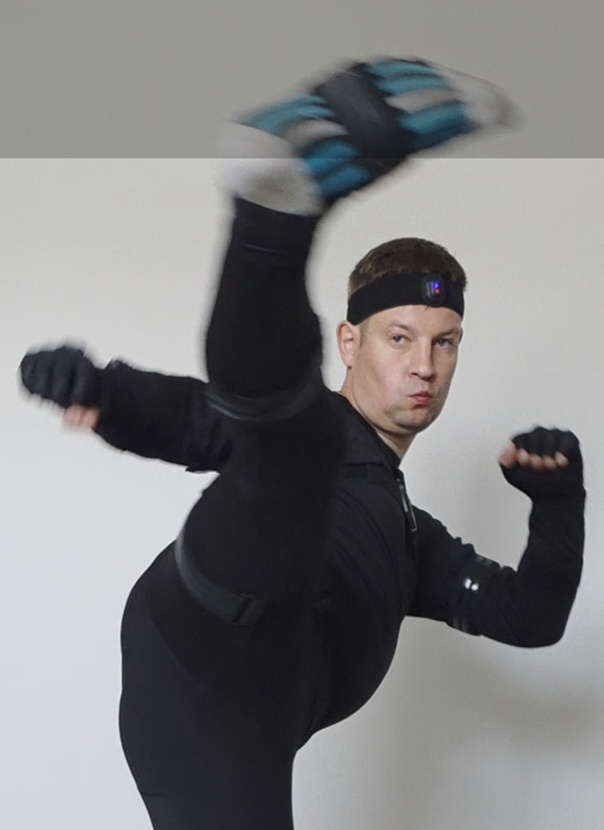
Patterns (tul/forms) are usually judged by eye. We asked whether fist-mounted IMUs can objectify rhythm, tempo and dynamics. One ITF athlete (male, 30 yrs, 56 kg, 160 cm) performed saju-jirugi with Noraxon Ultium sensors on the dorsal fists.
Maximal velocity of the striking (right) punch fell gradually from 11.68 m/s to 8.55 m/s across the sequence. The retracting opposite hand was faster on every punch (peak 12.67 m/s) without the same downward trend. Moderate correlation between hands’ peak velocities (r = 0.65); the strongest link involved the velocity difference and the retracting hand.
Linear and angular velocities both serve as performance markers depending on the capture setup. Case study — proof of measurement feasibility and a training-monitor idea, not a grading syllabus. Continues in our IMU strike diagnostics and Noitom Poland notes.
Hardware: Noraxon Ultium IMU mode (gyroscope ±2000°/s, accelerometer ±16 g, magnetometer ±4800 µT) with high sampling — the paper reports 2000 Hz acquisition for the inertial channels used. Sensors on both fists turn a form into a bilateral time series instead of a single aesthetic impression.
The falling striking-hand velocity across the saju-jirugi sequence, while the retracting hand stays fast, is a ready-made feedback metric for fatigue, rhythm loss or intentional tempo changes. Moderate inter-hand correlation (r = 0.65) suggests coupling without locking the limbs into identical peaks.
No DOI was registered for this Archives of Budo item in our ORCID clean list; cite volume 16, pages 195–202, and the ArchBudo abstract page. The measurement philosophy continues in open high-g strike hardware and Perception Neuron reference systems described on this blog.
Saju-jirugi is a compact bilateral sequence — ideal for a case study that must show whether fist IMUs survive real form tempo. Progress monitoring across weeks is the intended use case more than a one-shot viral clip.
How to read this without Instagram physics
Popular posts about martial arts love single numbers. Peer-reviewed combat-sport papers usually deliver distributions, small elite samples, and caveats. When we quote a median or a mean here, it is a laboratory reading under a stated protocol — pad or plate geometry, instruction to go maximal, a defined stance. Change the instruction or the target and the number moves. That is not a failure of science; it is why measurement exists.
Biokineticum’s role in these projects is the same as on the clinic floor: prefer a boring sensor over a loud opinion. If you want help instrumenting kicks or punches, or you need a physiotherapist who also writes the analysis code, the contact page is the honest next step — not a promise that your next roundhouse will match a table in Scientific Reports.
Final filter: if one table makes you rewrite an entire mesocycle or clinic pathway, pause. A single paper is a coordinate, not a season plan. Cross-check effect direction against the other ORCID-series posts, open the DOI, then edit the syllabus. We would rather see three coherent measurement sessions than one dramatic chart cropped for social media.
References
- Wąsik J, Mosler D, Góra T, Ortenburger D. Application of inertial sensors system for diagnosis of taekwon-do’s forms performance – a case study. Archives of Budo. 2020. 16:195–202. https://archbudo.com/view/abstract/id/13660
Measurement-led biomechanics and clinical tools at Biokineticum.