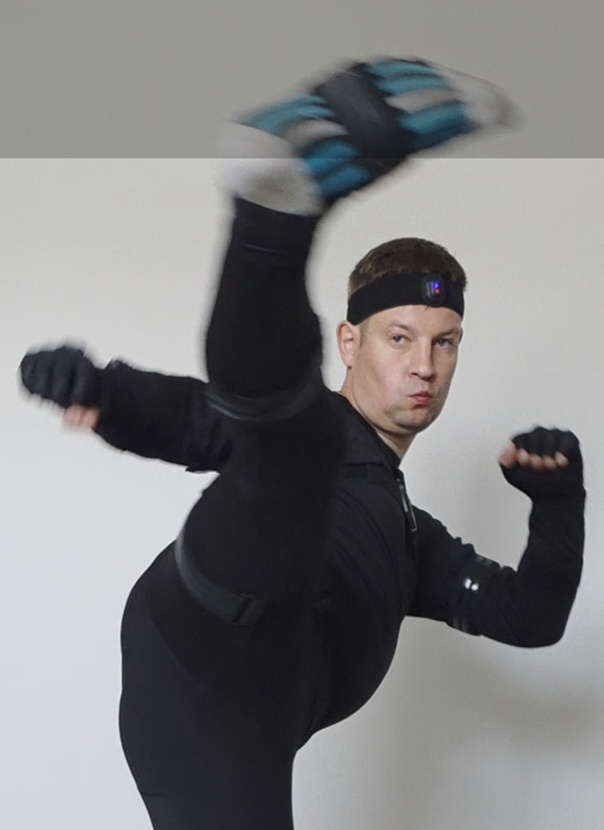
Case studies are unfashionable until you need numbers that survive contact with a shield. Four elite ITF men (age 28.5 ± 7.2, mass 77.5 ± 6.7 kg, height 180.0 ± 1.6 cm) produced 80 kicks into an AMTI-backed training shield.
Mean resultant impact force: side kick 4429.77 ± 1361.25 N vs turning kick 2648.98 ± 441.4 N — significantly lower for turning. Turning kicks with right vs left leg did not differ significantly. Vertical force component FZ correlated almost perfectly with resultant force (r ≈ 0.99 on both sides for turning).
Use case-series data to calibrate expectations in the gym, not to crown a world champion. Variability on the side kick (large SD) already warns against one-rep mythology. Pair with the effective-mass papers if you care why the plate reading diverges.
Athletes: mean age 28.5 ± 7.2 years, body mass 77.5 ± 6.7 kg, height 180.0 ± 1.6 cm — a tall, relatively homogeneous elite male group. Eighty kicks is enough to see the technique gap and the side-kick’s large standard deviation. That SD is a feature: maximal side kicks are noisy even among elites.
Near-perfect correlations between FZ and resultant force for turning kicks (r ≈ 0.988–0.994) simply remind you that the vertical channel dominated the resultant in this shield-on-plate geometry. Do not generalise that correlation to every pad angle in the wild.
Case-study framing is deliberate. We are not estimating population percentiles; we are documenting magnitudes coaches can sanity-check against their own instrumented sessions.
Shield-mounted AMTI MC12-2K captures a resultant that includes the padding’s filter. That is closer to a training tool than a bare plate, which is why we still like the design for ecological talk with coaches — with the SD kept in the sentence, not cropped out for drama.
How to read this without Instagram physics
Popular posts about martial arts love single numbers. Peer-reviewed combat-sport papers usually deliver distributions, small elite samples, and caveats. When we quote a median or a mean here, it is a laboratory reading under a stated protocol — pad or plate geometry, instruction to go maximal, a defined stance. Change the instruction or the target and the number moves. That is not a failure of science; it is why measurement exists.
Biokineticum’s role in these projects is the same as on the clinic floor: prefer a boring sensor over a loud opinion. If you want help instrumenting kicks or punches, or you need a physiotherapist who also writes the analysis code, the contact page is the honest next step — not a promise that your next roundhouse will match a table in Scientific Reports.
Final filter: if one table makes you rewrite an entire mesocycle or clinic pathway, pause. A single paper is a coordinate, not a season plan. Cross-check effect direction against the other ORCID-series posts, open the DOI, then edit the syllabus. We would rather see three coherent measurement sessions than one dramatic chart cropped for social media.
References
- Góra T, Mosler D, Langfort J, Wąsik J. Differences in Impact Force between Side Kicks and Turning Kicks in Male Practitioners of Taekwon-Do—Case Studies. Applied Sciences. 2024. doi:10.3390/app14135876
Measurement-led biomechanics and clinical tools at Biokineticum.