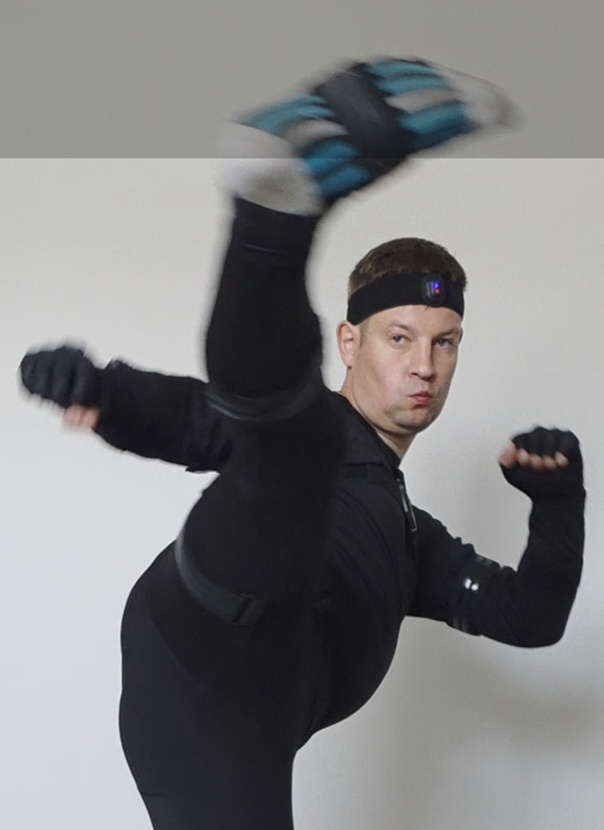
Crossref currently 404s this DOI prefix, but the paper is indexed (PubMed 30220721) and the abstract is clear. Eight well-trained men and six women kicked front kicks left and right into air, a board, a table-tennis ball and a training shield at solar-plexus height. Ten-camera Vicon MX40 at 250 Hz captured peak kicking-foot velocity.
Gender, leg and target type all influenced kicking speed (p < 0.001). The only significant interaction was gender × target (p < 0.001). Males’ max velocity responded more to the board; females’ more to target size (small ball). Coaching translation from the authors: board work may better raise kick quality for men; small-ball accuracy drills may better raise max velocity for women — in this cohort.
Note the DOI resolution glitch when citing; use the journal citation and PubMed ID alongside 10.5277/abb-01085-2018-02. Distinct from our later Kyokushin air-vs-target EMG paper — different art, different sensors, different question.
Targets: air (no physical target), board, hanging table-tennis ball, training shield — all at solar-plexus height. That matrix is why the gender×target interaction is interpretable: men and women did not merely differ in mean speed; they differed in which target pulled their maximum.
Authors’ coaching suggestion — board for male kick quality, small-ball work for female max velocity — should be treated as hypothesis-generating for this cohort (8+6), not a federation mandate. Test it in your club with a radar or mocap before you rewrite the syllabus.
PubMed PMID 30220721 remains the stable bibliographic handle while the 10.5277 DOI prefix fails Crossref resolution. We still cite the DOI string as printed in the journal. This front-kick velocity study is not a duplicate of the later Kyokushin EMG air-vs-target paper.
Vicon at 250 Hz is ample for peak foot velocity of a front kick. Lateral standing position standardised the start; solar-plexus height standardised the finish. The missing Crossref record is an indexing nuisance, not evidence the trial vanished.
How to read this without Instagram physics
Popular posts about martial arts love single numbers. Peer-reviewed combat-sport papers usually deliver distributions, small elite samples, and caveats. When we quote a median or a mean here, it is a laboratory reading under a stated protocol — pad or plate geometry, instruction to go maximal, a defined stance. Change the instruction or the target and the number moves. That is not a failure of science; it is why measurement exists.
Biokineticum’s role in these projects is the same as on the clinic floor: prefer a boring sensor over a loud opinion. If you want help instrumenting kicks or punches, or you need a physiotherapist who also writes the analysis code, the contact page is the honest next step — not a promise that your next roundhouse will match a table in Scientific Reports.
Final filter: if one table makes you rewrite an entire mesocycle or clinic pathway, pause. A single paper is a coordinate, not a season plan. Cross-check effect direction against the other ORCID-series posts, open the DOI, then edit the syllabus. We would rather see three coherent measurement sessions than one dramatic chart cropped for social media.
References
- Wąsik J, Ortenburger D, Góra T, Shan G, Mosler D, Wodarski P, Michnik R. The influence of gender, dominant lower limb and type of target on the velocity of taekwon-do front kick. Acta of Bioengineering and Biomechanics. 2018. 20(2):133–138. doi:10.5277/abb-01085-2018-02
Measurement-led biomechanics and clinical tools at Biokineticum.