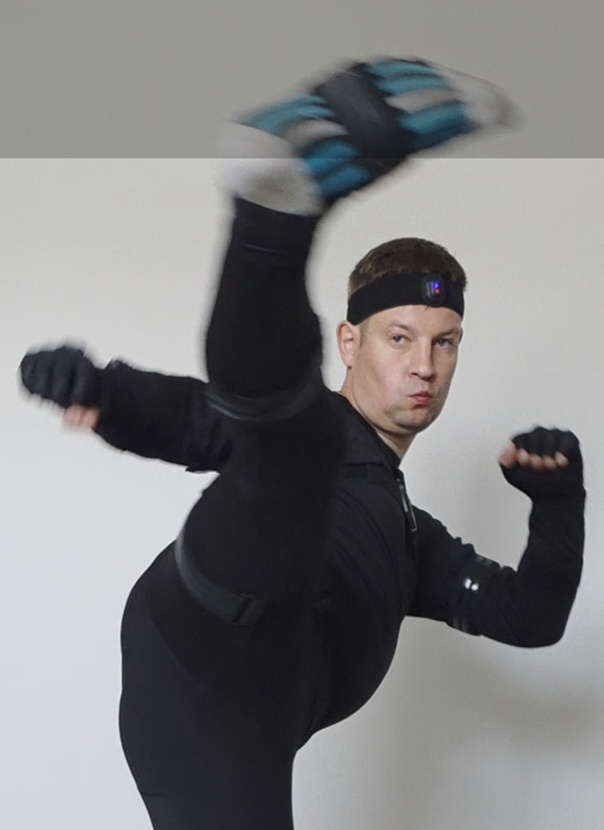
Most kicking papers still over-sample men. In Acta of Bioengineering and Biomechanics we asked a narrower question: in elite female ITF athletes, how do kinetic and somatic variables relate to kicking force for turning vs side kicks?
Five women (age 27.0 ± 4.8 years, mass 64.2 ± 5.8 kg, height 163.0 ± 6.5 cm) performed 100 kicks onto a padded strain-gauge platform. Side kicks averaged higher peak pressure force (1770 N) than turning kicks (1379 N) (p < 0.01).
Effective mass, not vibes
Effective mass as a percentage of body mass was about 18% for the turning kick and 85% for the side kick. Pressure force rose with effective mass — the boring, useful sentence coaches actually need. Lower-limb segment accelerations showed the inverse trend versus force: faster segments do not automatically mean a harder plate reading.
Limits
n = 5 elites, one federation style, lab target. Treat means as cohort evidence, not a ranking table for every club. Still: if you programme women only from male datasets, you are guessing.
For sensor-side diagnostics we use the same philosophy as in IMU strike work — numbers before folklore.
The somatic side of the question is easy to abuse. Height and mass are not destiny; they are covariates. What the Acta paper emphasises is the coupling between effective mass and pressure force: when more of the athlete’s mass participates at contact, the plate reading rises. That is why the side kick’s ~85% effective-mass fraction is operationally interesting next to the turning kick’s ~18% in this female cohort.
Inverse acceleration trends in the lower-limb segments are a useful coaching paradox. Chasing peak shank or foot acceleration in isolation can look “explosive” on a phone video while under-delivering force on a pad. Synchronisation and stiffening at impact belong in the cue list beside speed.
Five athletes means wide confidence intervals around any mean. Still, an all-female elite sample is rarer than it should be in combat-sport biomechanics, and the force gap between techniques replicates the direction seen in mixed and male cohorts from the same lab family.
One hundred kicks is a dense session for five athletes — enough to stabilise technique means inside a small elite group. The padded strain-gauge target protected hands and feet while keeping the plate’s mechanical path short. We treat 1770 N vs 1379 N as a within-sample contrast, not a federation standard for every weight class.
How to read this without Instagram physics
Popular posts about martial arts love single numbers. Peer-reviewed combat-sport papers usually deliver distributions, small elite samples, and caveats. When we quote a median or a mean here, it is a laboratory reading under a stated protocol — pad or plate geometry, instruction to go maximal, a defined stance. Change the instruction or the target and the number moves. That is not a failure of science; it is why measurement exists.
Biokineticum’s role in these projects is the same as on the clinic floor: prefer a boring sensor over a loud opinion. If you want help instrumenting kicks or punches, or you need a physiotherapist who also writes the analysis code, the contact page is the honest next step — not a promise that your next roundhouse will match a table in Scientific Reports.
Final filter: if one table makes you rewrite an entire mesocycle or clinic pathway, pause. A single paper is a coordinate, not a season plan. Cross-check effect direction against the other ORCID-series posts, open the DOI, then edit the syllabus. We would rather see three coherent measurement sessions than one dramatic chart cropped for social media.
References
- Góra T, Wąsik J, Mosler D, Ortenburger D. Relationship of kinetic and somatic variables to kicking strength in female taekwon-do athletes. Acta of Bioengineering and Biomechanics. 2025. doi:10.37190/abb-02592-2025-02
Measurement-led biomechanics and clinical tools at Biokineticum.