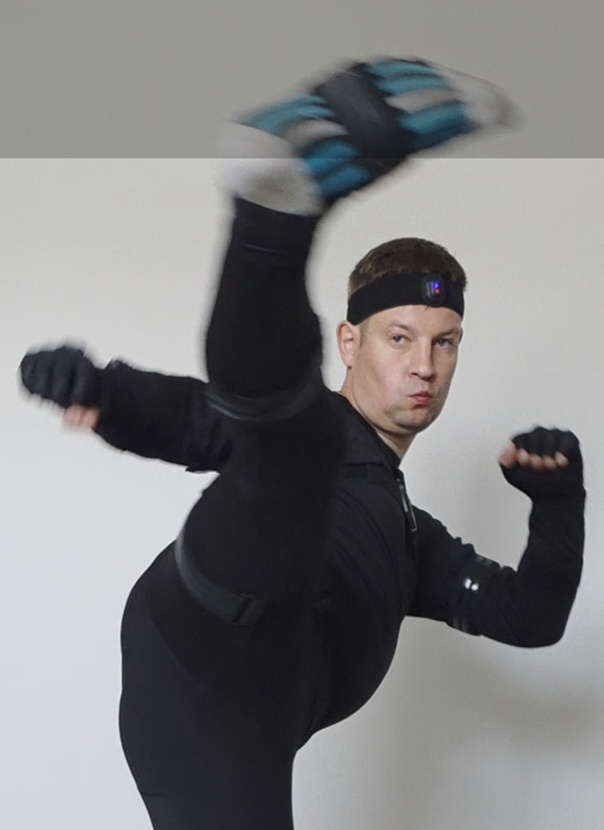
Batch-1 covered group effective-mass papers; this 2023 note is the single-master measurement that defines the conception cleanly. An ITF black-belt master (32 years, 60 kg, 160 cm) threw roundhouse, front kick, side kick and straight punch (three trials each) into a shield on an MC 12-2K plate with a Noraxon foot IMU. Effective mass Me = Fmax / a.
Force vs mass share vs contact time
Highest force: side kick 2406.9 ± 299.8 N; then roundhouse 2330.7 ± 71.2 N; lowest kick force front kick 2008.6 ± 284.8 N (punch nearly half). Shortest contact: roundhouse 0.026 ± 0.010 s; longest front kick 0.119 ± 0.052 s. Highest proportion of effective mass: front kick ~44%. Highest effect-of-force coefficient: roundhouse — other techniques looked more push-like.
Coaching line
Destructive power is not peak newtons alone. Contact duration and engaged mass decide. A front kick can recruit a larger Me share while a roundhouse wins the impulse-style coefficient. Measure Me in the dojang; do not rank techniques by ego.
Limits
n = 1 master case. Concept demonstration that pairs with the larger effective-mass series.
Accelerations on the foot IMU (e.g. side kick 106.3 ± 7.7 m/s², roundhouse 115.8 ± 11.3, front 64.3 ± 9.8) show why Me and Fmax rankings diverge: roundhouse is fast and brief; front kick slower with longer contact and larger Me share.
Engagement beyond the striking limb — roughly 24% of body mass equivalent discussion for front kick versus lower shares for roundhouse and punch in the paper’s interpretation — is the coaching gold. Stiffen the chain; do not only whip the distal segment.
Open DOI 10.16926/par.2023.11.02 beside the larger effective-mass series from batch 1.
Accelerations on the foot IMU (e.g. side kick 106.3 ± 7.7 m/s², roundhouse 115.8 ± 11.3, front 64.3 ± 9.8) show why Me and Fmax rankings diverge: roundhouse is fast and brief; front kick slower with longer contact and larger Me share.
Engagement beyond the striking limb — roughly 24% of body mass equivalent discussion for front kick versus lower shares for roundhouse and punch in the paper’s interpretation — is the coaching gold. Stiffen the chain; do not only whip the distal segment.
Open DOI 10.16926/par.2023.11.02 beside the larger effective-mass series from batch 1.
Where this sits in the lab
Biokineticum’s public notes exist so practitioners can reach the DOI without drowning in jargon — and so athletes, teachers and clinicians see that combat-sport science also publishes on prisons, faith, fair play, sauna physiology and disability policy. Soft topics still deserve hard methods: sample sizes, instruments, effect directions and explicit limits.
If you teach, treat or coach from these findings, copy the reference list into your syllabus, open the full text, and write down what you will measure next week. That is the only CTA that always fits.
How to read this without Instagram physics
Popular posts love single numbers. Peer-reviewed papers usually deliver distributions, small samples and caveats. When we quote a mean or a median here, it is a laboratory or questionnaire reading under a stated protocol. Change the instruction or the sample and the number moves.
Final filter: one paper is a coordinate, not a season plan. Open the DOI, then edit the syllabus.
References
- Wąsik J, Mosler D, Góra T, Scurek R. Conception of effective mass and effect of force – measurement of taekwon-do master. Physical Activity Review. 2023. 11(1). doi:10.16926/par.2023.11.02
Measurement-led biomechanics, health psychology and clinical tools at Biokineticum.