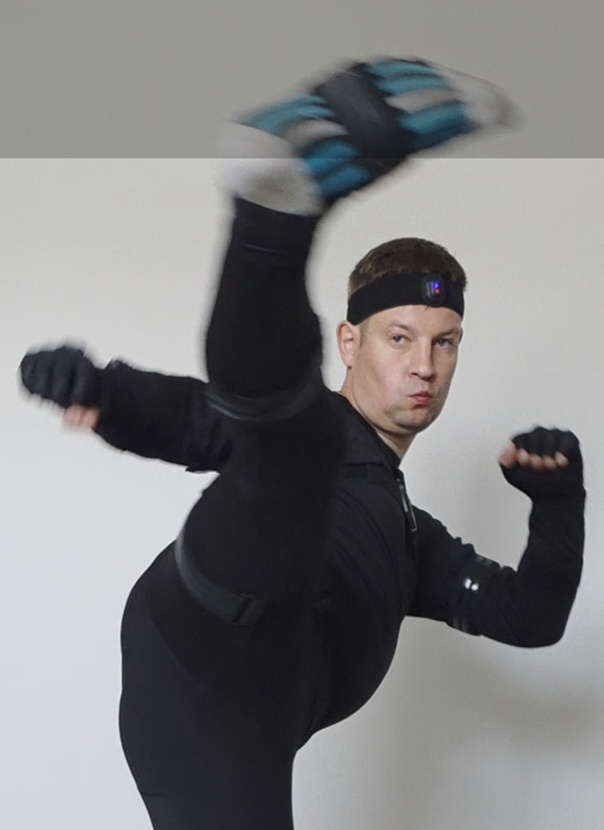
Body weight on the scale is not punching — or kicking — power. Effective mass is the fraction of your mass that participates at impact. In Applied Sciences four adult male ITF athletes wore a Noraxon IMU on the foot, synchronised with a force plate.
Median pressure force: 2661.53 N for the turning kick and 4596.15 N for the side kick, with foot accelerations of 150.56 m/s² and 74.34 m/s² respectively. Median effective mass: about 20.12% of body mass (turning) vs 73.09% (side).
No statistically significant right–left differences in the kinetic variables (p > 0.05) in this sample. Small n — read as a mechanistic case series with clear technique contrast, not a ranking of clubs.
Training translation
Side kicks reward organising the body so more mass arrives with the foot; turning kicks often trade mass for speed. If you only chase peak foot acceleration, you may be optimising the wrong knob. Same idea as in our boxing effective-mass notes — different limb, same physics.
Foot acceleration was higher on the turning kick while force and effective mass were higher on the side kick. That dissociation is the pedagogical core: speed of the distal segment and mass recruited into the impact are not the same variable. IMU–plate synchronisation (Noraxon with the force platform) is what makes that dissociation visible instead of anecdotal.
Absence of significant laterality effects here does not prove athletes are symmetrical forever. It means that in this small male ITF sample, side-to-side kinetic differences did not clear the significance bar. Keep testing bilaterally when stakes are high (injury return, title fights, grading).
Pair this paper with the female Acta dataset and the sex-differences PAR paper if you coach mixed groups — the direction of the technique contrast is stable; the absolute newtons are not interchangeable across sexes and body sizes.
Effective mass was derived from synchronised force and acceleration — the same conceptual Me = F/a family used in our boxing work, applied here to kicks. Four athletes limit external validity; they do not limit the clarity of the ~20% vs ~73% body-mass contrast between turning and side kicks in this male set.
How to read this without Instagram physics
Popular posts about martial arts love single numbers. Peer-reviewed combat-sport papers usually deliver distributions, small elite samples, and caveats. When we quote a median or a mean here, it is a laboratory reading under a stated protocol — pad or plate geometry, instruction to go maximal, a defined stance. Change the instruction or the target and the number moves. That is not a failure of science; it is why measurement exists.
Biokineticum’s role in these projects is the same as on the clinic floor: prefer a boring sensor over a loud opinion. If you want help instrumenting kicks or punches, or you need a physiotherapist who also writes the analysis code, the contact page is the honest next step — not a promise that your next roundhouse will match a table in Scientific Reports.
Final filter: if one table makes you rewrite an entire mesocycle or clinic pathway, pause. A single paper is a coordinate, not a season plan. Cross-check effect direction against the other ORCID-series posts, open the DOI, then edit the syllabus. We would rather see three coherent measurement sessions than one dramatic chart cropped for social media.
References
- Góra T, Mosler D, Podstawski R, Wąsik J. The Impact of Effective Mass on the Strength of Side and Turning Kick in Taekwon-Do Male Practitioners. Applied Sciences. 2024. doi:10.3390/app14062339
Measurement-led biomechanics and clinical tools at Biokineticum.