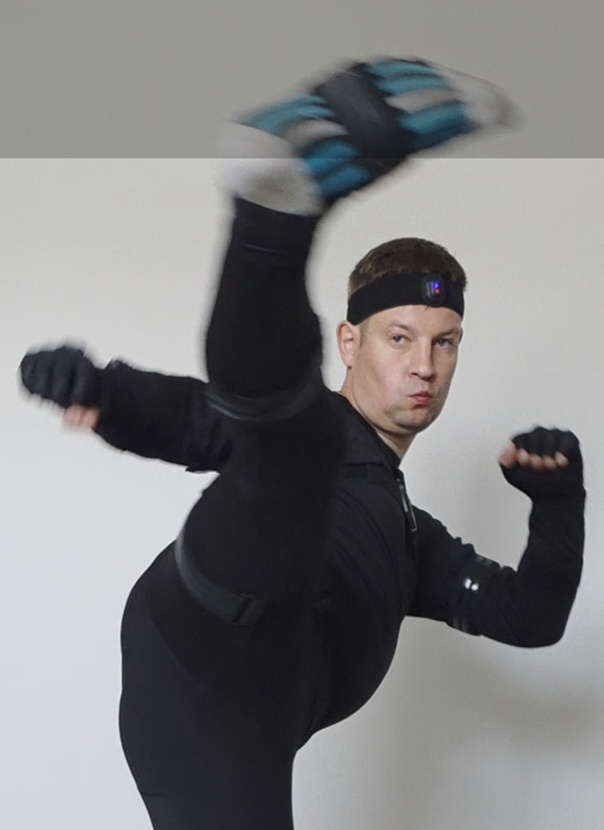
Distance is not just “how far you stand”. We defined effective distance (Δd) as how far peak fist velocity sits from the moment of contact. One male black-belt taekwondo athlete (20 yrs, 65 kg, 171 cm) threw sport punches at a ping-pong ball in the Human Motion Lab — three left, three right.
Punch velocities ranged 6.20–8.01 m/s. Momentum passed to the ball rose markedly when effective distance sat between 1.12–1.73%. When effective distance sat between 3.70–3.95%, ball velocity after impact dropped by nearly half. Closer timing of max velocity to contact correlated with higher contact velocity (r = 0.95, p < 0.01).
Preliminary, single-athlete — but the coaching cue is clean: do not peak early and hope. Arrange the strike so the velocity curve still has something left at contact. That is distance management as physics, not mysticism.
Human Motion Lab capture of a light target (ping-pong ball) makes post-impact object velocity a readable proxy for momentum transfer. The new term “effective distance” formalises something coaches already feel: peaking too early wastes the strike.
The 1.12–1.73% window versus the 3.70–3.95% window is not a universal constant for every weight class — it is what this athlete produced in this task. The correlation (r = 0.95) between closer Δd and higher contact velocity is the transferable idea. Train so that max velocity is not a museum piece three centimetres before the pad.
Point-fighting rulesets that punish uncontrolled force make dosage of impact a competitive skill. Effective distance is one knob on that dosage, next to effective mass and intent.
Preliminary analysis means hypothesis-building. The r = 0.95 line is strong inside this dataset; replication across athletes and punch types is the obvious next laboratory step before anyone sells an “effective distance app”.
How to read this without Instagram physics
Popular posts about martial arts love single numbers. Peer-reviewed combat-sport papers usually deliver distributions, small elite samples, and caveats. When we quote a median or a mean here, it is a laboratory reading under a stated protocol — pad or plate geometry, instruction to go maximal, a defined stance. Change the instruction or the target and the number moves. That is not a failure of science; it is why measurement exists.
Biokineticum’s role in these projects is the same as on the clinic floor: prefer a boring sensor over a loud opinion. If you want help instrumenting kicks or punches, or you need a physiotherapist who also writes the analysis code, the contact page is the honest next step — not a promise that your next roundhouse will match a table in Scientific Reports.
Final filter: if one table makes you rewrite an entire mesocycle or clinic pathway, pause. A single paper is a coordinate, not a season plan. Cross-check effect direction against the other ORCID-series posts, open the DOI, then edit the syllabus. We would rather see three coherent measurement sessions than one dramatic chart cropped for social media.
References
- Wąsik J, Ortenburger D, Góra T, Mosler D. The influence of effective distance on the impact of a punch — Preliminary Analysis. Physical Activity Review. 2018. 6:81–86. doi:10.16926/par.2018.06.11
Measurement-led biomechanics and clinical tools at Biokineticum.