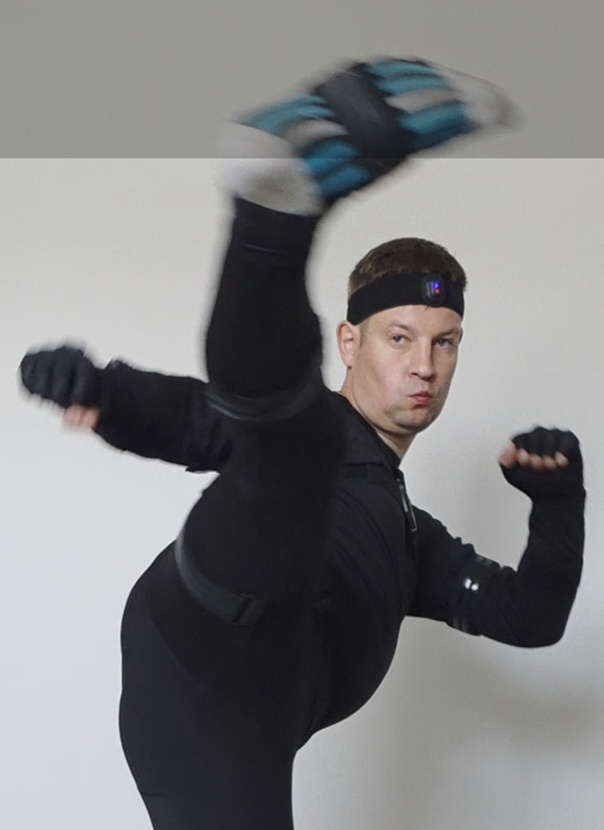
Epidemiology of injuries from vertical obstacles is thin. We compared kinematics when an assistant pushed two combat-sports-trained men into a concrete wall from a 2-metre start: man A, 65, lifelong judoka/teacher of safe falling; man B, 24, physiotherapist, amateur judo plus a specialist safe-fall course. MVN Biomech (XSENS) captured four collisions each.
Shared and different
From upper-limb contact to stopping the centre of mass, both lifted and flexed the arms to shield the head — contact surface nearly identical. Man A amortised better: mean head-mass accelerations about 16% lower; energy absorbed by body tissues about 77% vs 91% for man B (A dissipated more effectively), aided by post-impact knee flexion and larger sagittal centre-of-mass travel.
Training beats birthdays here
Suitable long-term training let the retiree-age athlete amortise a hard vertical collision more effectively than the younger adult with shorter experience. Specialist safe-fall coursework plus years of judo still raise protective ability when external force drives you into a wall — and such simulations belong in permanent health-related training.
Limits
n = 2 case comparison, controlled pushes. Mechanism lesson, not population norms.
The assistant standardised the push: one hand on the neck, one on the lumbar spine, similar force each trial, subject facing the wall relaxed at 2 m. That external-force design matters — it is not a self-initiated breakfall demo.
Head protection via arm elevation was shared; the difference lived in post-impact segmentation and energy bookkeeping. Lifelong practice showed up as quieter head acceleration and smarter dissipation, not as comic-book invulnerability.
Include wall-collision simulations in permanent health-related training if you already teach safe falls — with mats, medical sense and progressive intensity. Archives of Budo 2015;11:27–39 is the citation.
The assistant standardised the push: one hand on the neck, one on the lumbar spine, similar force each trial, subject facing the wall relaxed at 2 m. That external-force design matters — it is not a self-initiated breakfall demo.
Head protection via arm elevation was shared; the difference lived in post-impact segmentation and energy bookkeeping. Lifelong practice showed up as quieter head acceleration and smarter dissipation, not as comic-book invulnerability.
Include wall-collision simulations in permanent health-related training if you already teach safe falls — with mats, medical sense and progressive intensity. Archives of Budo 2015;11:27–39 is the citation.
Where this sits in the lab
Biokineticum’s public notes exist so practitioners can reach the DOI without drowning in jargon — and so athletes, teachers and clinicians see that combat-sport science also publishes on prisons, faith, fair play, sauna physiology and disability policy. Soft topics still deserve hard methods: sample sizes, instruments, effect directions and explicit limits.
If you teach, treat or coach from these findings, copy the reference list into your syllabus, open the full text, and write down what you will measure next week. That is the only CTA that always fits.
How to read this without Instagram physics
Popular posts love single numbers. Peer-reviewed papers usually deliver distributions, small samples and caveats. When we quote a mean or a median here, it is a laboratory or questionnaire reading under a stated protocol. Change the instruction or the sample and the number moves.
Final filter: one paper is a coordinate, not a season plan. Open the DOI, then edit the syllabus.
References
- Michnik R, Jurkojć J, Wodarski P, Mosler D, Kalina RM. Similarities and differences of the body control during professional collision with a vertical obstacle of men aged 24 and 65. Archives of Budo. 2015. 11:27-39. Full text / abstract
Measurement-led biomechanics, health psychology and clinical tools at Biokineticum.