📌 Key Findings in Simulation-Based Medical Education (SBME)
- Cognitive Mastery: Research shows simulation training reduces cognitive load during real patient encounters by up to 35%, allowing clinicians to focus on complex differential diagnostics.
- Zero-Risk Failure Environment: Virtual patients allow students and practitioners to test biomechanical hypotheses, make mistakes, and understand consequences without endangering patient health.
- Bridging Theory & Kinematics: Interactive tools like PhysioSim merge textbook anatomical principles with real-time kinematic calculations and 3D visualization.
- Reproducibility: Standardized virtual cases allow uniform assessment of clinical decision-making across universities and training institutions.
In high-stakes industries such as aviation and aerospace, pilots spend hundreds of hours in flight simulators mastering crisis scenarios before ever taking control of a commercial aircraft. Yet in healthcare and physical therapy education, students have historically transitioned directly from 2D textbook diagrams to live patients with acute pain and complex pathologies.
Today, Simulation-Based Medical Education (SBME) is redefining how clinical skills and biomechanical intuition are acquired. By creating interactive virtual patient scenarios, we can dramatically enhance diagnostic accuracy, confidence, and treatment formulation.
1. What the Educational Science Demonstrates
Extensive meta-analyses in medical and allied health education (Cook et al., 2011; Lateef, 2010) highlight the profound effectiveness of simulation:
Key cognitive benefits include:
- Deliberate Practice & Instant Feedback: Students can repeat diagnostic tests (e.g. Lachman test, straight leg raise, postural balance screen) multiple times until motor and analytical patterns are perfected.
- Error Reflection Without Harm: In a simulator, misinterpreting a compensatory gait pattern or choosing an inappropriate loading parameter serves as a powerful learning moment rather than a clinical injury.
- Dynamic Biomechanical Modeling: Simulators visualize internal joint forces, lever arms, and muscle activation vectors that are completely invisible during standard physical observation.
2. Introducing PhysioSim: The Virtual Clinical Simulator by Biokineticum
To bring these educational advances into daily practice, the Biokineticum team developed PhysioSim—a specialized virtual clinical training simulator for physiotherapists, university students, and sports science specialists.
PhysioSim features:
- Interactive Patient Encounters: Case-based scenarios covering spine disorders, knee ligament tears, shoulder impingements, and neuromuscular balance deficits.
- Real-Time Kinematic Visualizer: Powered by Three.js and Python biomechanics scripts, allowing users to rotate, examine, and quantify 3D skeletal movement.
- Differential Diagnostic Tree: Test hypotheses, select orthopedic tests, analyze simulated video kinematics, and formulate evidence-based therapy plans.
Explore PhysioSim & BioKinEdu Software
Discover our free open-source biomechanical tools, Python kinematic scripts, and interactive virtual clinical training platform.
View Educational Software & Tools →3. The Future of Physiotherapy Training: Sensor Integration & MoCap
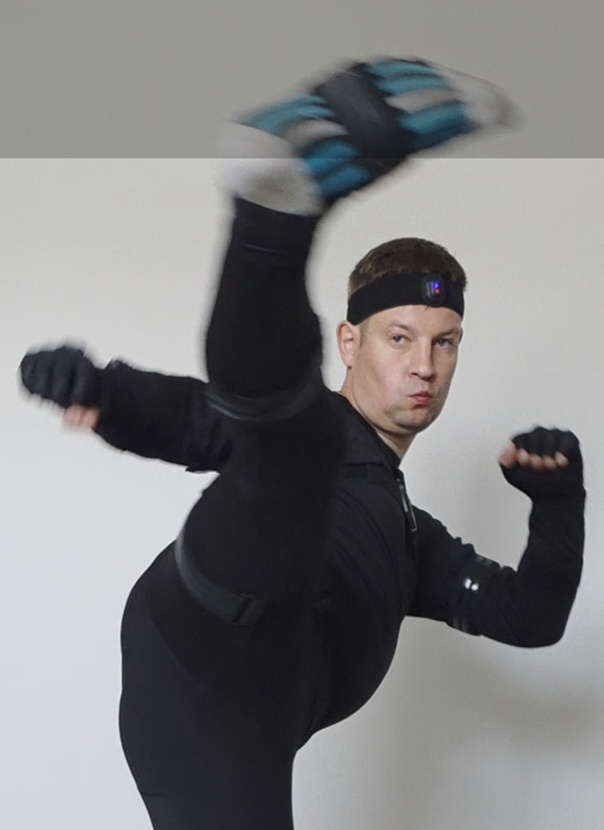
Beyond screen-based simulations, the next frontier is combining virtual simulations with Inertial Measurement Units (IMU) such as wireless inertial sensor systems. This allows students to wear sensors, execute rehabilitation movements themselves, and observe their real-time biofeedback superimposed onto digital anatomical avatars.
1. Cook, D. A., Hatala, R., Brydges, R., et al. (2011). Technology-enhanced simulation for health professions education: a systematic review and meta-analysis. JAMA, 306(9), 978-988.
2. Lateef, F. (2010). Simulation-based learning: Just like the real thing. Journal of Emergencies, Trauma, and Shock, 3(4), 348-352.
3. Mori, B., Carnahan, H., & Herold, J. (2015). Use of simulation for teaching and learning in physical therapy education: A systematic review. Physiotherapy Canada, 67(3), 255-265.
4. Mosler, D. (2024). Open-source Python kinematics for educational biomechanics in allied health. Biokineticum Scientific Series.