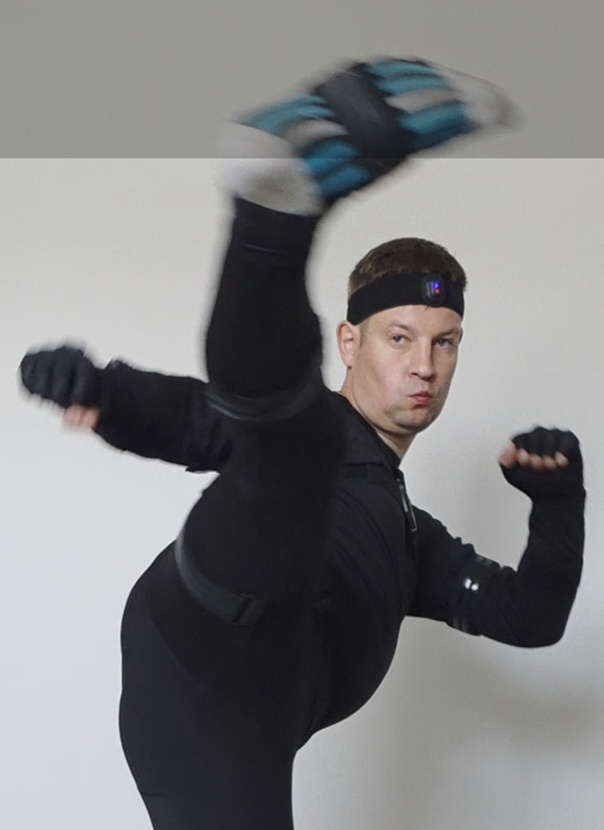
In modern, evidence-based sports biomechanics, measuring the targeted physical force of a devastating strike typically requires insanely expensive and cumbersome laboratory equipment (e.g., dynamometric force plates built into walls or floors measuring in Newtons). Because of this, many coaches choose to rely on instinct and their own eye in the gym to optimize punches, completely rejecting technological engineering.
We decided to challenge this. My latest publication, combining physiotherapy and Data Science exploration, published with the entire research team in the esteemed journal Acta of Bioengineering and Biomechanics (2025), touches upon a technological breakthrough in the world of sports. We thoroughly investigated whether the application of complex neural networks and deep learning technology—specifically the Long Short-Term Memory (LSTM) model combined with common and ultra-cheap microscopic motion sensors (arrays of miniature IMUs)—can "replace" sterile, heavy laboratory equipment.
Methodology: How Do We Teach Computers to "See" the Force of Human Neural Circuits?
We fed the machine learning system millions of unstructured sequences of human strikes. The precision was acquired by asking a selected elite group of 20 master competitors of the Korean martial art to serially execute a lethally effective side kick—commonly known as turning kicks (Dollyo Chagi)—into a classic front measurement platform, powerfully recording the generated force in hundreds of kilograms with the precision of a Swiss watch.
This process was largely standard. The real magic of the engineering lay in embedding a dense network of tiny IMU sensors along the biomechanical axes of the thighs and on the tested athletes' shins in the background. These tiny "dots" gathered measurement noise across thousands of parameters in the cloud millisecond by millisecond—tracking spatiotemporal acceleration readings, coordinates, and segment alignment angles across all run-up stages in empty air. The gigantic input dataset then went straight into the ribbon of our artificial convolution model (LSTM Network). The algorithm was given an ostensibly trivial programming task: to solve an optimization function. Its goal over millions of computational loop iterations was to continuously examine the relationships between movement, noise, and tilt angles of the attacking leg with the subsequent documented verdict of the dynamometer ultimately crushed from that reading. In a word: we taught AI the correlation between seeing temporal limb parameters and the final destructive outcome, without the AI even seeing the target impact itself!
Research Results. What Did Our Personalized AI Model Reveal?
The data returned after dozens of hours of training the neural network exceeded our team's ambitions by almost an entire length of research deviations. We specified this around:
- The Model's Impressive Hyper-Accuracy over Humans: In a properly partitioned validation test block of our measurements, this digital LSTM model, seemingly oblivious to everything but dry mathematical matrices, achieved a confidence level mapping correlation R² fluctuating in the genuinely terrifying thresholds of up to 0.972–0.978! For physiotherapists without an engineering passion, this translates to a clear conclusion: artificial intelligence "understood" the mechanism of human body mass thrown into a strike so deeply that it predicts the actual, physically delivered destructive force measured on the pad with nearly deadly one-hundred-percent accuracy, solely by viewing the pre-kick acceleration timeframe from tiny Bluetooth chips hidden in dobok fabrics. The errors amounted to micromillimeters on the scale of the athlete's entire body.
- Undiscovered Parameters and Secrets of Powerful Kicks: Software engineering methods introduced to verify the autonomous decision tree workflow of this multidimensional LSTM program led us to a higher stage of initiated structural movement analysis. During an advanced scanning and profiling phase (feature validity analysis) to understand via which ladder of weights the program verified a knockout from a multitude of signals... Surprisingly, it was the AI algorithm that made us humans (as medical researchers) realize what should perpetually be the main focal point. The models concluded this objectively, ensuring themselves a thousand times over, that the enormous (most potent) significance of aligning the entire striking potential (including the leg in the final Taekwon-do impact fragment) is held by the modest dorsiflexion of the lowest fraction—the ankle joint—in correlation with the time the rest of the chain flows out of the hip! AI found a measurable anomalous bottleneck of human striking power via the objective optimization of pure, cold logic from numbers gathered in error clouds, where many still presume to place the main emphasis on large powerful lumbar flexions and momentums on straight joints and knees.
Innovation Perspectives – What Does the Arrival of AI Mean for Coaches on Mats and in Gyms?
My deep conviction is singular: this pioneering experimental study proves the arrival of a magnificent era bounded by limitless new analytical possibilities in professional sports. The creation of Data Science engines for load predictions, combined with minimal setups comprising almost battery-free inertial sensors costing just a few bucks, opens the incredibly grand gates of large-scale innovation for the hundredth time beyond the hermetic world of underground biomechanics institutes.
Thanks to full optimization and validation models, today we scientists are perfectly able to measure destructive capabilities, test athletes under sweaty predictive loads for fractions of grams of pressure on the meniscal patella, or estimate rehabilitative muscle strength progress directly post-ligament-reconstruction right under the sterile canvas of a real ring – without expensive dynamometer resistance platforms and the restricting walls of a laboratory. Athletes, during their most optimal real-world tests, perform empty, loose, natural forms onto boxing bags, spongy pads, or the void of an imagined opponent using pure stress-free physiology for the legs. In the background, an artificial brain with a dataset tells us exactly how that leg will deliver its full power with scalpel-like precision, and why a tiny technical breakdown of momentum right above the ankle just cost a gold medal. And that, in essence, is the power of technology supporting human physiotherapeutic care.
Mosler D., Błażkiewicz M., Góra T., Bednarczuk G., Wąsik J. (2025). Using a long short-term memory model to predict force values of Taekwon-do turning based on spatio-temporal parameters. Acta of Bioengineering and Biomechanics.