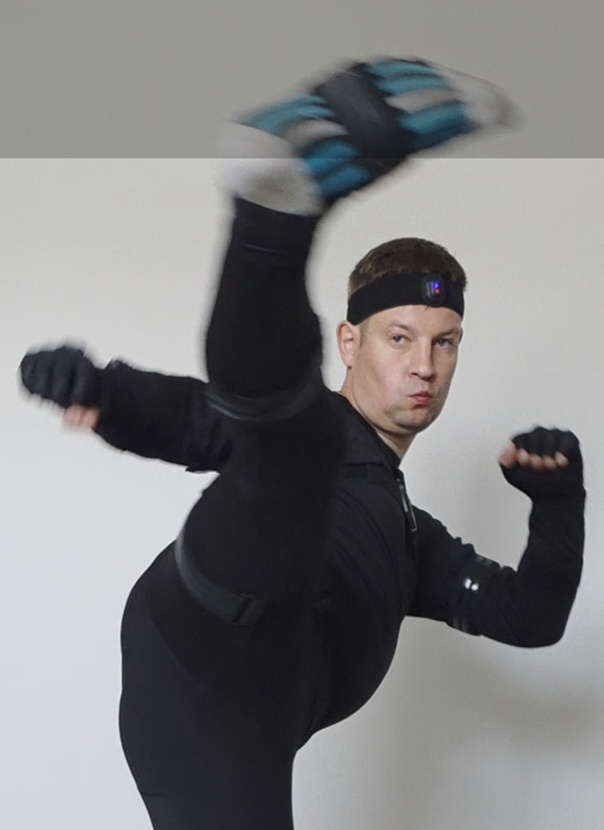
A frequently repeated truth in martial arts is that punching or kicking power does not come from the arm or leg alone. To verify this with hard data, we conducted detailed studies, the results of which were published in the prestigious Journal of Human Kinetics (2023).
Our primary aim of the study was to assess how individual body segments (trunk, arms, legs) behave during the execution of a lower limb strike, specifically the roundhouse kick, for both the left and right foot.
How Did We Conduct the Research?
The measurements were taken in the specialized, certified Human Motion Lab, where 13 elite Taekwon-do competitors, all holding numerous achievements and black belts, gathered for the tests.
To record their natural movement with millimeter precision, we utilized a Motion Capture system consisting of 10 dedicated infrared cameras. We tracked special reflective markers (landmarks) that were carefully attached to the competitors' key joints and spaces — including toes, knees, pelvis/hips, chest (sternum), and the arms themselves (wrists and forearms). We instructed the athletes to repeatedly deliver their strongest roundhouse kicks at a suspended tennis ball, using it as a target, since, as a physiotherapist and researcher, I know perfectly well that a heavy bag would act as an inhibitor and "distort" the raw, fully natural kinetic flow of the leg in its final phases of displacement.
Key Discoveries
During the arduous analysis of thousands of frames from the collected data, we arrived at extraordinarily significant conclusions that were statistically confirmed:
- Record Speed: As expected, the foot reached its highest velocity just before the impact phase – yielding overwhelming statistics: an average of around 13 meters per second, but peaking at 16.58 m/s for the fastest participant, which roughly converts to nearly 60 km/h!
- Reinforcing human asymmetry is a myth among experts: It turned out that no significant differences were observed in the mean absolute velocity of the kicking leg, regardless of whether it was the preferred (usually right) dominant leg or the non-dominant left side. These outstanding results unequivocally prove the perfectly mastered bilateral training of athletes in this class.
- Where do the minimal differences between the right and left side come from?: Although the final developed velocity in the foot was identical, the algorithms detected statistically significant different behaviors in the upper body parts. We discovered differences in the deceleration dynamics of the trunk movements (measured at the sternum) and the opposite shoulders depending on the rotation with the selected leg.
What Does This Mean in Practice for You?
As a scientist and data analyst, I frame conclusions in numbers, but of equal importance to me is their direct application in professional practice or during rehabilitation in my clinic. During our calculations, we simply noticed a huge and positive statistical correlation between the velocity and displacement parameter on the upper limb girdle markers, and the final velocity achieved by the kicking leg (correlation level r=0.782, an exceptionally high rate rarely seen in the motor system and in-vivo body size measurements).
Thanks to this, we know scientifically and definitively: a correct, striking movement always starts with the so-called "shoulder shot". The force of the initial stretch passes through a cascading, rapid rotation of the hips, traveling in the blink of an eye through the joint spaces of the knee, so that, just like at the tip of a cracking whip, its multiplied and released potential kinetic energy strikes straight into the foot delivering the actual blow just at the end of its flight.
This directly implies that the initial swing of the opposite arm along with the twist of sudden energy on the trunk are absolutely key, if not the most important mechanism transferring the appropriate downward striking trajectory to the muscles for the entire kick to be executed correctly and deliver the maximum force to the target – because the body is not an assembly of separate screws. It is an interconnected linkage of functional organs and fascia. It is impossible to generate a powerful leg strike, or to create optimal postoperative gait compensations for patients with ailments and injuries, without perfectly efficient deep muscles stabilizing our axis, commonly referred to as the "core".
Wąsik J., Mosler D., Ortenburger D., Góra T., Podstawski R. (2023). Differences in Velocities of Crucial Body Segments while Executing Roundhouse Kicks for Both Sides. Journal of Human Kinetics, 86, 97-105.
DOI: 10.5114/jhk/159451