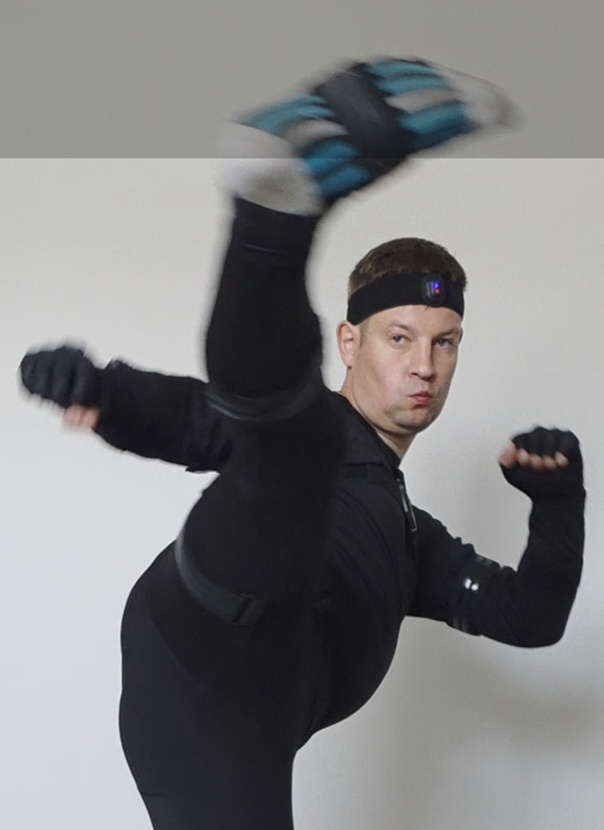
A vast majority of traditional training during Karate classes worldwide (including the extremely demanding Kyokushin branch), is spent honing famous techniques in the air (the so-called kihon or shadowboxing forms). Hundreds of thousands of punches thrown outward at high speeds seem like excellent overall conditioning due to the dynamic necessity of forcefully decelerating the body utilizing its own muscular strength.
But what if the collision with a physical, corporeal target pad is physically much more crucial to our locomotive system, and simply cannot be substituted? To investigate the target kinematic effect, I collaborated on a new publication in the Physical Activity Review (2025), with hopes of obtaining undeniable, precise evidence on the subject.
Methodology – How Was the Measurement Look Like?
For detailed trials, our measurement and research team selected an elite squad of 19 strong men with black belts who are highly decorated competitors in classic Kyokushin Karate. We equipped them with state-of-the-art gear - they wore multiple highly responsive, microscopic, and wireless IMU inertial sensors on their bodies to gather three-dimensional frequency data.
Readings from the sensors adhered to their thighs, pelvises, shins, and bare feet indicated instantaneous proper acceleration in real-time. However, what is most vital from my perspective as a physiotherapist and researcher, is that we attached devices from a wireless surface electromyography (sEMG) system to selected areas of the participants' legs. It was capable of reading, with microvolt precision, the electrical potentials activating a specific muscle – utilizing simultaneous measurement covering 7 key muscle bellies in the lower extremities. In this setting, we asked the examined fighters to perform a highly specific sequence of the fastest frontal Mae-Geri kicks – first completing three reps into empty air (the No-Target execution), and a blink later, executing the same strikes aiming firmly at special impact pads (Targeted-kicks).
Measurement Results: What Does the Physical Target Change?
Our digital algorithms processing millions of frames per second discovered striking dissonances in their physiological behavior between these, at first glance, identical executions:
- A Drastic, Twofold Jump in Acceleration: The moment the leg learned through measurable experience that it was going to hit a target (a thickly held physical resistance pad), we recorded a higher intensity of shock in the foot's trajectory. Its maximum achieved instantaneous acceleration nearly doubled – fluctuating quite high among the best results from a modest average of 57.83 m/s² during the classic kick into the ether of empty air straight up to downright insane registries hitting cosmic metrics of 99.27 m/s². The difference speaks for itself.
- Absolute, Higher Targeted Speed: The statistical data regarding peak measured metric speeds, especially fine-tuned over the duration of the session (perhaps due to the strong "bag penetration" effect, commonly higher ballistic potential to find target dissipation and impact beyond "point x"), also rose along with the averaged achieved flight velocity of the tibia. A targeted front kick among the fighters heightened peak velocity readings up to 16.91 m/s (with a target pad) as opposed to only defensively reduced values of 14.39 m/s for the free technique executed into empty space.
- Muscle Work is a Surprise!: We expected proportional anomalies resulting from a different mapping of explosive contractions. However, the measurable collisions of bioelectrical potentials fed directly into the EMG machines on the seven thigh bellies documented far more consistency than discrepancies in both activation movements across both conditions. This means the sheer schema, the pattern of the recruited sequencal body motor memory was exceptionally coherent in both conditions, with only a minor nuance regarding an earlier start and predominance on the target side for the rectus femoris – while the entire physical distinction in dynamics emerged solely due to the purely uncompromising biokinetic force of unblocked vector deceleration without restraint.
Expert Conclusions – For Coaching Practice and Injury Prevention Evidence
The conclusions forged for the rigorous dojo environment are simple to implement with biomechanics knowledge - empty training absolutely works, as it perfectly cements the neuronal code of the sequence for the proper recruitment of the leg chain (practicing techniques on an empty mat develops habits of proper tension and biomechanical angles during force dissipation, without extreme impact-deceleration loads on thigh joints and feet).
Nonetheless, hard data irrefutably and scientifically show that a full kinetic test – drawing out sheer acceleration, maximum power, striking precision in the split second of the projectile's flight – can only be naturally funneled through the central system in the real world for strikes executed into a physical, firm target designated for impact. This target receives the striking vector without destroying cartilage via constant empty decelerations in the joints (eliminating the "shooting without a barrel" paradox effect). Therefore, models of training programs shouldn't evolve to cut out the great tradition of "kihon", but rather, aligned with the wonderful technological era of EBP – they must strive further for an optimal balance of hard impact in targeted combat forms, minimizing injuries while pushing fighters' statistics beyond the physical limits of pads.
Mosler D., Góra T., Kaczmarski J., Błaszczyszyn M., Chociaj M., Borysiuk Z. (2025). Target Kinematic Effect in Kyokushin Karate Front Kicks: An Analysis of Velocity, Acceleration, and Muscle Activation Patterns. Physical Activity Review, 13(1): 156-166.