In combat sports, it is a common belief that a lead hand strike, frequently known as a jab (left straight for orthodox fighters), is primarily used for "measuring" distance, whereas the rear hand – the cross (right straight) – carries devastating knockout power. Common opinion also assumes that a faster punch is automatically a stronger punch. In our latest research publication conducted with the team, featured in the highly regarded journal Applied Sciences (2024), we decided to verify this theory using objective kinetic metrics.
The main objective of the study was to measure the actual parameters of two fundamental boxing punches – the lead jab and the rear cross. We wanted to thoroughly verify the assumption that the faster the punch is executed, the more mass it carries, which from a biomechanical perspective is often a massive oversimplification.
What Did the Experiment Look Like?
To collect 100% reliable data, we invited 13 advanced boxing competitors with extensive ring experience to our laboratory. Because we are talking about professional measurement analysis, strikes against the target (simulating a heavy bag) were not only recorded visually but were absorbed by a certified, integrated force plate, which precisely measured the generated impact force and mass transfer applied at the point of contact.
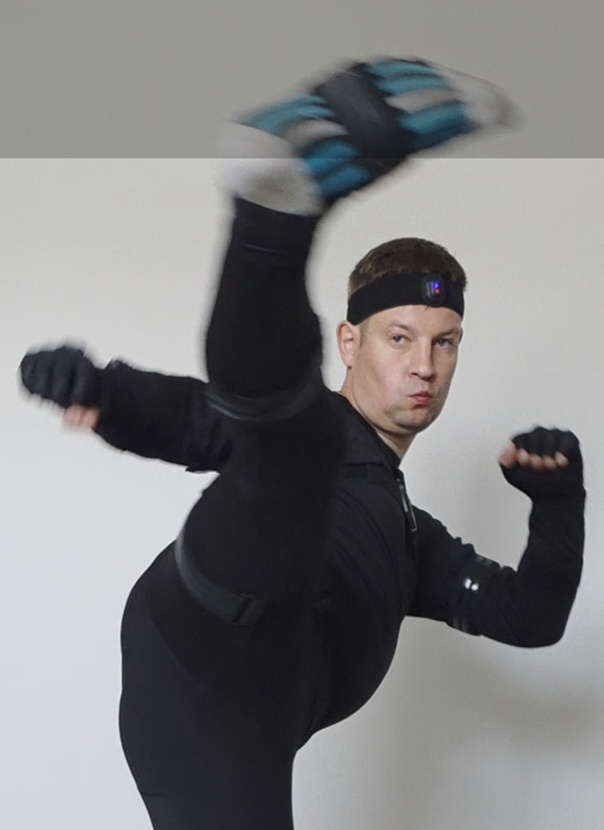
Additionally, we utilized modern micro-technology – deploying miniature, wireless, and extremely sensitive inertial IMU sensors on the key vectors of the fighters' striking arms, specifically at the wrists, the forearm, and the upper arm itself, in order to record the absolute instantaneous acceleration of the arms tracking toward the measurable resistive wall.
What Did the Measurements Reveal?
A comparison of these two structurally distinct punches revealed fascinating insights and definitive numbers:
- Absolute force is unforgiving: The definitive measurement winner turned out to be the rear hand strike (cross). The average force generated by the boxers for this punch was nearly 1709 Newtons. In contrast, the projected lead jab recorded impacts at an average of 1176 Newtons.
- Speed does not equal acceleration: The lead jab is anatomically a shorter punch, commonly perceived as much "faster" upon release from the guard, serving as a base strike. Nevertheless, contrary to public opinion, it was the rear hand that exhibited remarkably high acceleration parameters of up to 94 m/s² at the collision of the rear clenched fist right before the impact phase (for the lead jab, the fist showed an estimated acceleration of around 66 m/s²).
- The Significance of Systemic Parameters: A detailed mathematical regression model tangibly proved that the fighter's pure body mass and training experience gained with age have the greatest overall impact on generating the ultimate, optimal, and devastating measurable force upon striking the target.
Conclusions for Coaches and Athletes
The biggest surprise to some athletes is the realization that the driving force of a knockout rear straight punch (cross) is not merely the mass distribution of the tensed arm musculature. This proves once again the validity of a holistic physiotherapeutic perspective on the kinematic chain of the human body.
The advantage of the cross over the lead hand lies in a significantly longer generated path of kinetic transfer. Properly generated force is a process – a fraction of a second of complex muscle engagement of the whole body, driven by appropriately transferred impact from the forceful pushing out of the muscles straight from the feet and the ground, which, combined with the momentum of violent ballistic rotation in the trunk (axial segment), is ultimately and densely "launched" onto the forearm acting as the striking instrument.
For coaches and patients recovering from injuries, this means one thing – one should always train multi-joint and neuro-motor body coordination progressing from its foundational anchors, commonly known as building from the proximal segment (closer to the trunk) toward the extremities - the distal segment, rather than relying on the isolated power of a strong bicep or shoulder to program knockout statistics.
Mosler D., Kacprzak J., Wąsik J. (2024). Higher Values of Force and Acceleration in Rear Cross Than Lead Jab: Differences in Technique Execution by Boxers. Applied Sciences, 14, 2830.